
AI is already changing how people shop. From zero-click search results to AI-generated product recommendations, customers are no longer navigating the traditional journey of clicking through paid ads or organic listings. Instead, AI assistants and summaries like Google’s AI Overviews curate the content they see, serving results instantly, often without a single click.
For global retailers, this brings content localisation front and centre. Because what those AI models choose to surface depends heavily on how relevant, well-structured, and locally adapted your content is. If it’s not in the right language, doesn’t feel market-appropriate, or lacks the nuance to resonate, AI engines (including ChatGPT) might not include your site or social platforms in the bank of data that it uses to power its results.
The statistics bear this behavioural change out. According to Bain & Company, 80% of consumers use AI-driven summaries and zero-click results at least 40% of the time (Bain Insights). And that number is only going to increase over time.
For international retail brands, this shift means one thing: if your retail content isn’t localised, well structured, and culturally relevant, it may not get seen at all.
How is AI shopping making localisation even more urgent?
We already know personalisation matters:
- 71% of UK consumers expect personalised experiences (Salesforce, 2024)
- 60% are more likely to buy from brands that personalise messaging (Econsultancy, 2023)
- 42% say irrelevant content frustrates them (Salesforce, 2024)
Now imagine that dynamic playing out across 10 languages, 15 markets, and every possible digital channel. Retailers can’t afford to rely on one-size-fits-all messaging anymore; we need to focus on global discoverability.
Source: SEMrush via Retail Week
If AI is eating the funnel, localised content is your defence.
As more shoppers rely on AI-generated answers, what gets surfaced depends on the quality, structure, and localisation of your content. If your product pages aren’t in the right language, or your campaign message doesn’t feel native, then you’re not going to win that AI-powered recommendation.
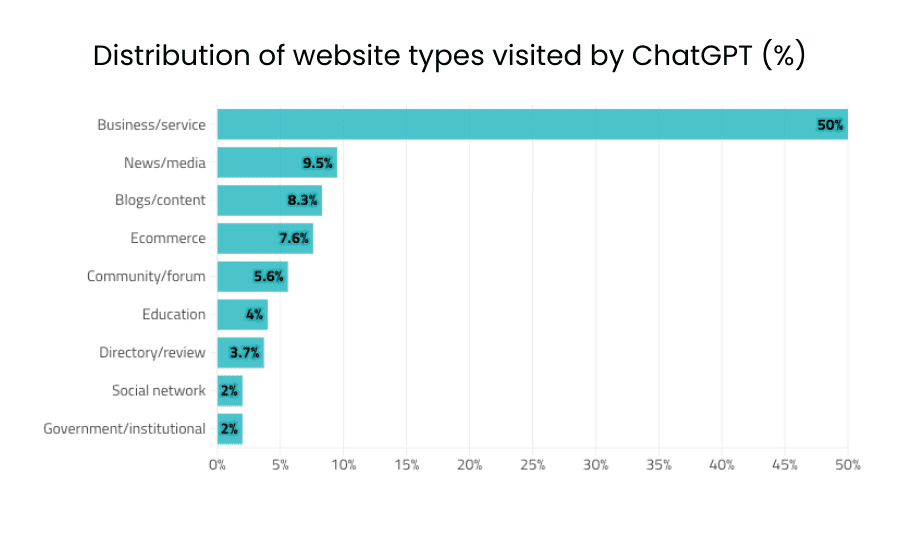
And here’s the thing: research by SEMrush shows that ChatGPT gets half its content from business/service pages. That means that your site, the content it houses, is the most important thing to get right for the market you’re trying to grow:
Some of the biggest brands are already tapping into national and even regional localisation to gain ground on their competitors:
- Coca-Cola was an early adopter of global personalisation, using local names on cans and varying these by country (here’s the list of Spanish names, which even include typically Basque names such as ‘Iker’)
- Amazon uses AI and human editing to generate localised product listings in over 20 markets
- Sephora varies tone and creative across the US, France, and Southeast Asia to match cultural norms
The challenge: Scaling personalisation without losing control (or breaking the bank)
Until recently, delivering this kind of tailored experience required huge teams and even bigger budgets. At the same time, it was notoriously messy and, let’s be honest, painful. It wasn’t uncommon for us to see clients come to us with a non-English project that would be trailing full weeks, months or even years to match the customer experience that was offered to UK shoppers. Not ideal!
Now, AI is helping retailers scale global content at fractions of the time and cost, without compromising brand or quality.
With our own retail clients, we’ve seen it for ourselves: AI, when trained and deployed well, lets you:
- Adapt tone and messaging by market
- Tailor product copy, paid media, and SEO for different regions
- Translate high-volume content faster and more consistently
- Scale video localisation across languages and platforms
And a quick note on SEO: what lots of brands don’t realise is that it’s not just about translating the copy accurately. Buying behaviour varies by country, so the SEO copy needs to reflect that. For example, an SEO campaign for a German travel brand would have to reference “first class tickets”, since it’s more common to travel first class there than it is in the UK, especially on regional services, since it offers better odds of getting a seat during rush-hour travel.
💡 Watch our full webinar on SEO and localisation to learn more.
Which AI solutions are actually moving the needle for global brands?
We offer a range of AI-based translation solutions that cover every channel, budget and time constraint:
- MTAP (Machine Translation + Automated Post-Editing)
This is the technology behind our proprietary self-service AI tool, Pronto, which is ideal for delivering speed and consistency across product pages and long-tail content. - MTPE (Machine Translation + Human Post-Editing)
A hybrid solution blending the best of AI technology with human oversight, which is ideal for campaign content or anything customer-facing where tone matters. - Multilingual content creation tools
Generate original content in multiple languages directly from a single brief, no English source needed. Perfect for product descriptions, social content, and long-form landing pages. Also really handy for SEO, where local buyer behaviour should be taken into account (see the German train ticket example above). - AI voiceover and subtitles
Scale your video content without studio costs, adapting tone and delivery by market. We have lots of resources to help explain how to do this well.
Why it makes sense to partner with a localisation expert to scale more quickly
AI won’t replace your content team. But it will help you do more, faster, if you get the setup right.
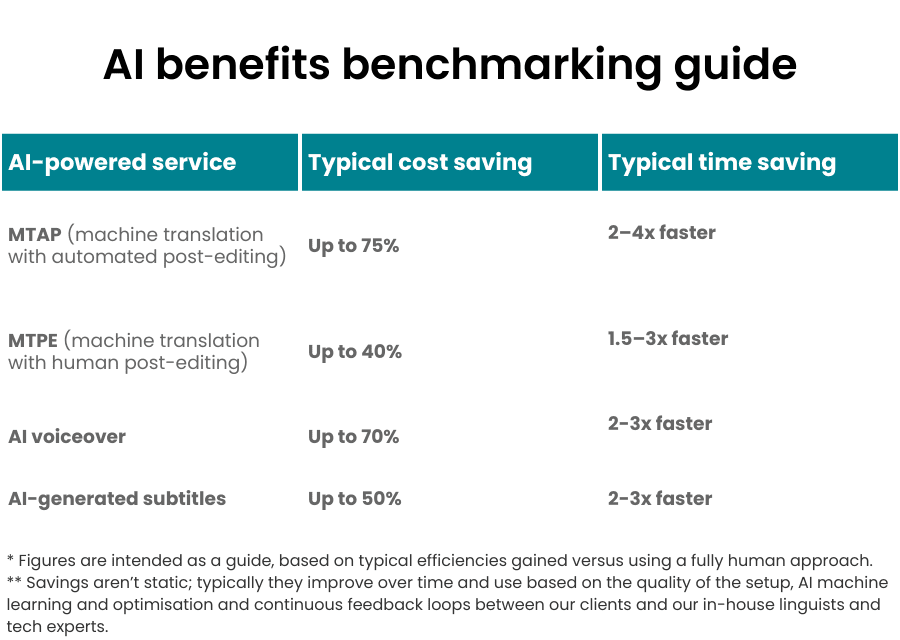
These are the benchmarking figures we use to help our clients get a feel for how much time and money they’ll save by incorporating AI-driven localisation into their workflows:
Real-world example: Pronto has cut spending for a retail client by 75%
We recently worked with a UK retail client managing over 10,000 SKUs across multiple European markets. Using our MTAP-powered platform, Pronto, they were able to centralise localisation, apply brand-specific prompts, and go live in days, not weeks.
The result? Quicker launches, consistent tone, and up to 75% cost savings compared to their traditional process.
As tempting as it is to “go it alone” when introducing AI, the reality is that choosing the right tool, configuring it, and training it on your brand and markets is a highly specialised and highly skilled task. It’s a challenge that needs localisation experts as much as tech gurus.
At Comtec, we’ve had years of experience doing just that. We’ve seen what works, what doesn’t, and where the investment in AI really pays off.
To give you an idea of our approach, this is the framework we use to get clients started:
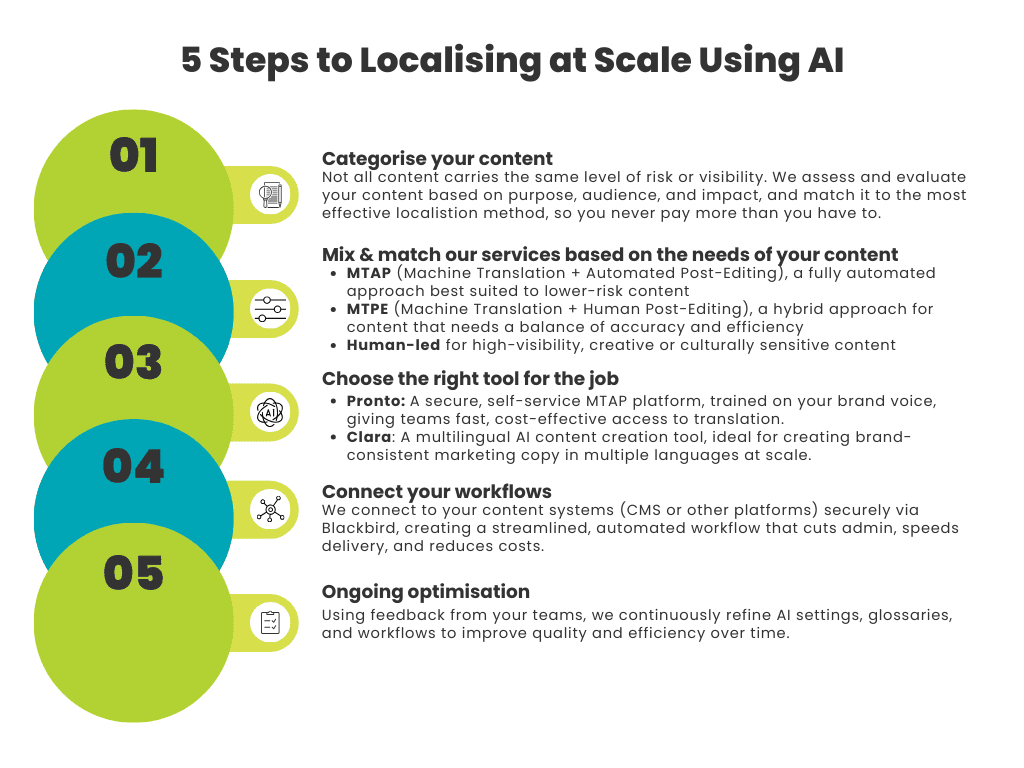
Our strategic approach, coupled with years of hands-on experience means we know what we’re doing and can help our clients focus on growth that moves the needle.
Want to explore what this could look like for your brand?
If you’re serious about scaling personalisation and want to stay visible in an AI-powered world, start with the right strategy and setup.
Our latest guide for international retailers breaks down how to use AI to localise content faster, with less effort, and without compromising on brand voice.
Inside, you’ll find:
- Information on benchmarks and best practices
- A thorough breakdown of the different localisation methods available
- Practical advice and tips on when to use AI and when to bring in human expertise
- Real client examples and tech recommendations to help you plan with confidence
📥 Download the full guide or contact me at ebrittain@comtectranslations.com.