
“Oh, and we’ll need this in 12 languages.”
It’s the kind of thing you hear at the end of a kick-off call, almost as an afterthought, and usually only once the learning content is agreed. It sounds simple enough, but this is what catches people out: whether a multilingual project runs smoothly has very little to do with how many languages the client needs, and everything to do with when those localisation decisions are made.
The good news is that none of this has to be complicated. It comes down to a handful of decisions, made in the right order, before delivery begins. Here’s how to get them right.
Why "We need this in 12 languages" is never just about translation
When a client says they need something in multiple languages, they’re usually thinking about translation, not localisation. Translation is the process of swapping words from one language to another, while localisation is about adapting the content to ensure it lands just as well in French, Spanish, Korean, whatever it might be, as it does in English.
To give a real-world example, learning content written for the UK might include names or scenarios in a case study module that would be completely foreign to someone living and working in India. Without localisation, your learners might feel confused or even offended, and overall engagement, completion and retention rates will almost certainly be affected.
So behind that single line in the client’s brief sit a dozen considerations: which markets is the training for, and which matter most; which translation method suits which type of content; how audiovisual assets are handled; who reviews each language; how feedback and versions are managed; and what sign-off looks like.
As the agency delivering the training, you control every one of those decisions. Confirm them at the start, and the project stays on the timeline and the quote you agreed on. The work that tends to erode the margin is rarely the translation itself; it is the coordination that builds up when those decisions are left open.
The five questions you need to ask before you price a project
These five questions, asked before you finalise scoping and costing, remove most of the uncertainty and give you a better understanding of exactly what will be involved in delivery.
- What kind of learning content is it? Systems training is not the same as a diversity and inclusion refresher. Break the programme down by type rather than treating it as one job.
- What does it need to do? Some content just needs to inform, some needs to change behaviour, build trust or carry a brand voice. The ultimate goal of the content should influence the approach.
- What formats are involved? eLearning, subtitles, video and voiceover, downloadable PDFs, on-screen text, interactive elements. Formats drive timeline and cost more than word count does.
- Which languages and markets do you really need? Watch for regional variants, and confirm them properly. “Spanish” could mean the Spanish spoken in mainland Spain, or Mexican or Latin American Spanish, and the vocabulary, grammar and tone are very different. Of course, it could mean both, in which case that’s multiple deliverables, not one.
- Who reviews each language, and what are they looking for? Accuracy, terminology, legal aspects, brand consistency? A designated local-market reviewer needs a clear remit of what they’re checking for, otherwise you’re exposed when it comes to someone objecting on the grounds of personal taste.
Expert tip: Match the asset to the localisation approach, don’t use one method for the whole programme
The other decision that dramatically affects costing is recognising that not every asset needs the same level of localisation.
A single programme might contain eLearning modules, video scripts, subtitles, voiceover, on-screen text, workbooks, assessments, and LMS copy, each of which may require a slightly different approach.
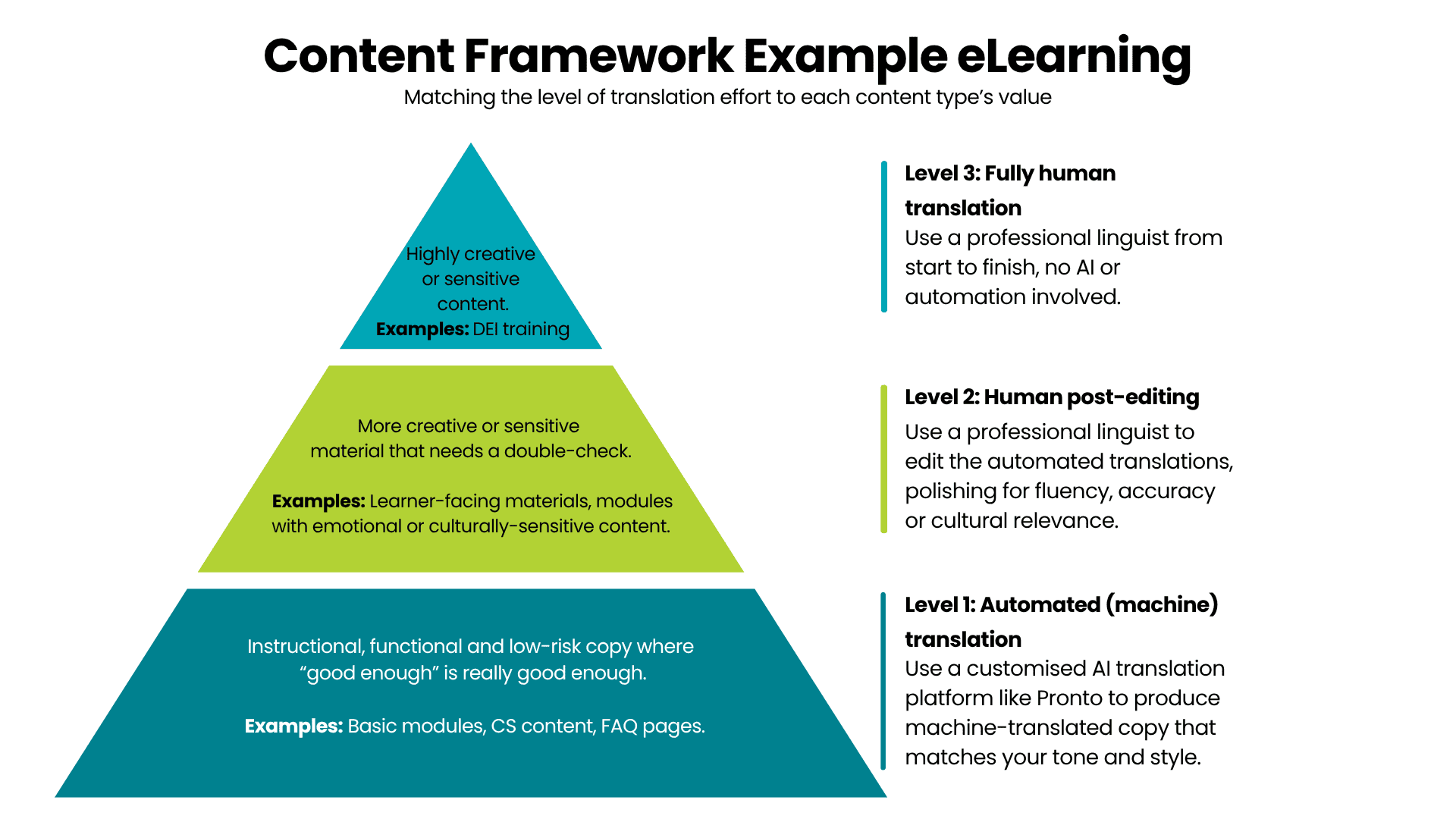
Translation options sit on a spectrum, from fully AI to fully human, and the skill is matching each asset to the right method.
Here’s a quick breakdown:
- AI-led localisation suits high-volume, lower-risk content, where speed and cost matter, provided the AI has been set up for your client’s terminology and domain.
- Machine translation with human post-editing is where most core learning content belongs; the AI does the heavy lifting, and a qualified linguist reviews it for accuracy, tone, and instructional clarity.
- Fully human translation, or transcreation, is the right call for high-risk, sensitive, certified, or brand-critical content, where a translation error carries real consequences.
How to know when you need human intervention
Raw machine output can look fine on the surface, but used as-is, without a linguist shaping it for the learner, it often reads as stiff or slightly off, the kind of thing that makes a learner switch off or misread the point.
You can read more in our case study, where we tested fully AI, human-edited and fully human side-by-side; it’s a great way to better understand exactly what’s involved and what changes at each service level.
Knowing where AI saves money safely, where human review protects the learner experience, and where full human input is the only responsible choice is what stops you from overpaying for some content and under-protecting the quality or impact of the rest.
FREE TOOL: Want to know if you’re over- or under-translating your learning content? This tool helps you find out.
Moving from order-taker to strategic partner
As an agency partner, the real value you bring isn’t the translation itself; it’s the judgment around it, knowing which questions to ask, which content needs which approach, and where it’s actually worth spending more. That’s the difference between being handed a brief and being asked for advice, and the second one is a far better place to be, both for the relationship and your revenue targets.
Taking a strategic role in the localisation process also changes how you handle the questions clients love to ask once a project’s in flight. When someone says, “Can’t we just use AI for all of this?“, the strategic partner starts with what the content needs to do, explains where AI is actually the smart choice and where it would cost them later, and offers a quick sample so they can see the difference for themselves rather than take your word for it.
You stop competing on who’s cheapest and start being the person they trust to get it right, which tends to be the same person they call for the next project.
Final thought
The opportunity for learning agencies with global clients is to make localisation an explicit part of any project, and to consider it early, before pricing and delivery begin.
When localisation is properly scoped, you quote with more confidence, protect margins, manage local stakeholders more easily, and give clients real confidence in their launch dates. AI gets easier to explain, too, because it becomes one part of a balanced approach rather than a blanket answer.
The bottom line is that localisation really doesn’t have to be complicated. A handful of conversations at the start, and everyone comes out ahead: you, your client, and the learners it’s all for.
If this is something you’re facing with a client now, we’re happy to help you scope and price. Send us a project outline, proposal or content list, and we will review it with you for free, flag where localisation complexity might appear, where AI-led workflows could fit, and what to clarify before delivery begins.