
Everyone’s talking about AI translation right now. And with good reason: it’s up to 80% cheaper and 50–75% faster than traditional human translation. Tools like Pronto, Comtec’s self-service AI translation platform, can turn around content in minutes instead of weeks.
But here’s the thing nobody tells you: AI on its own won’t scale your localisation.
If you simply throw all your content into a machine, you’ll get a mix of content that just about works, some that sounds like a human wrote it, and some that sounds… well, pretty bad.
The difference between chaos and control is what you do before you press “translate”. We’re talking about content categorisation; using a framework that sorts your content and markets into tiers, and matches each tier with the right level of translation, from pure AI to human transcreation.
Get that right, and AI isn’t just fast and cheap; it becomes the engine of a scalable localisation strategy.
Why content categorisation matters (a.k.a. how to stop wasting money)
Typically, our clients are producing more content now than ever before. It’s common for us to hear of teams rolling out a Europe-wide or global restructure, launching new sustainability policies, or opening up five new markets, all within 12 months.
After that initial launch phase, you move into a “new normal”, settling into new processes and demands in terms of content production. And what does that look like in practice?
It means that you’re producing more content than ever, from HR policies and compliance training to product guides, knowledge bases, and campaign copy. It’s manic and often messy because your localisation workflows haven’t caught up with the new demands on your business.
Think about it: global businesses are cranking out content like never before. Marketing launches a campaign every week, HR distributes new training every quarter, and customer service teams are increasing the amount of content readily available online.
If you treat every single file as equally important, you’ll:
- Blow your translation budget (very quickly!)
- Slow down global launches
- Dilute your brand voice
And the data clearly supports having a solid translation strategy:
- 76% of consumers are more likely to buy if information is in their own language (CSA Research, 2020).
- 89% of marketers are planning to expand into more languages, reflecting positive ROI outcomes from previous investment into translation (Nimdzi)
- Digital content is growing at a staggering pace; the IDC reports data volume increased by 28% in 2023, effectively doubling every 2–3 years (CFA Institute). Without doubt, there is more content needing localisation than ever before.
A content framework is the precursor to developing your localisation strategy; its purpose is to sort your content into tiers, so that you match the service level to the needs of that particular piece of text.

Not everything needs a VIP treatment, so assessing the value of each content type helps you make better decisions regarding how much time and money to invest in the translation approach.
A framework for content categorisation
In essence, the trick is to match effort to reward (or risk).
- Less visible, simple or functional copy can be adequately translated using AI, as long as that AI is trained on your brand and terminology. You don’t need to pay for a human to do either the original translation or a post-edit.
- More sensitive content needs a human post-editor. Consider the complexity of the language and the potential impact if it were incorrect. You can use automated translation to get the bulk of the work done quickly and affordably, but then have a professional linguist conduct a detailed review of the AI translation, ensuring it’s spot on for your intended audience.
- Highly sensitive, creative, or regulated content requires human translation or transcreation by a professional linguist, with no involvement from AI.
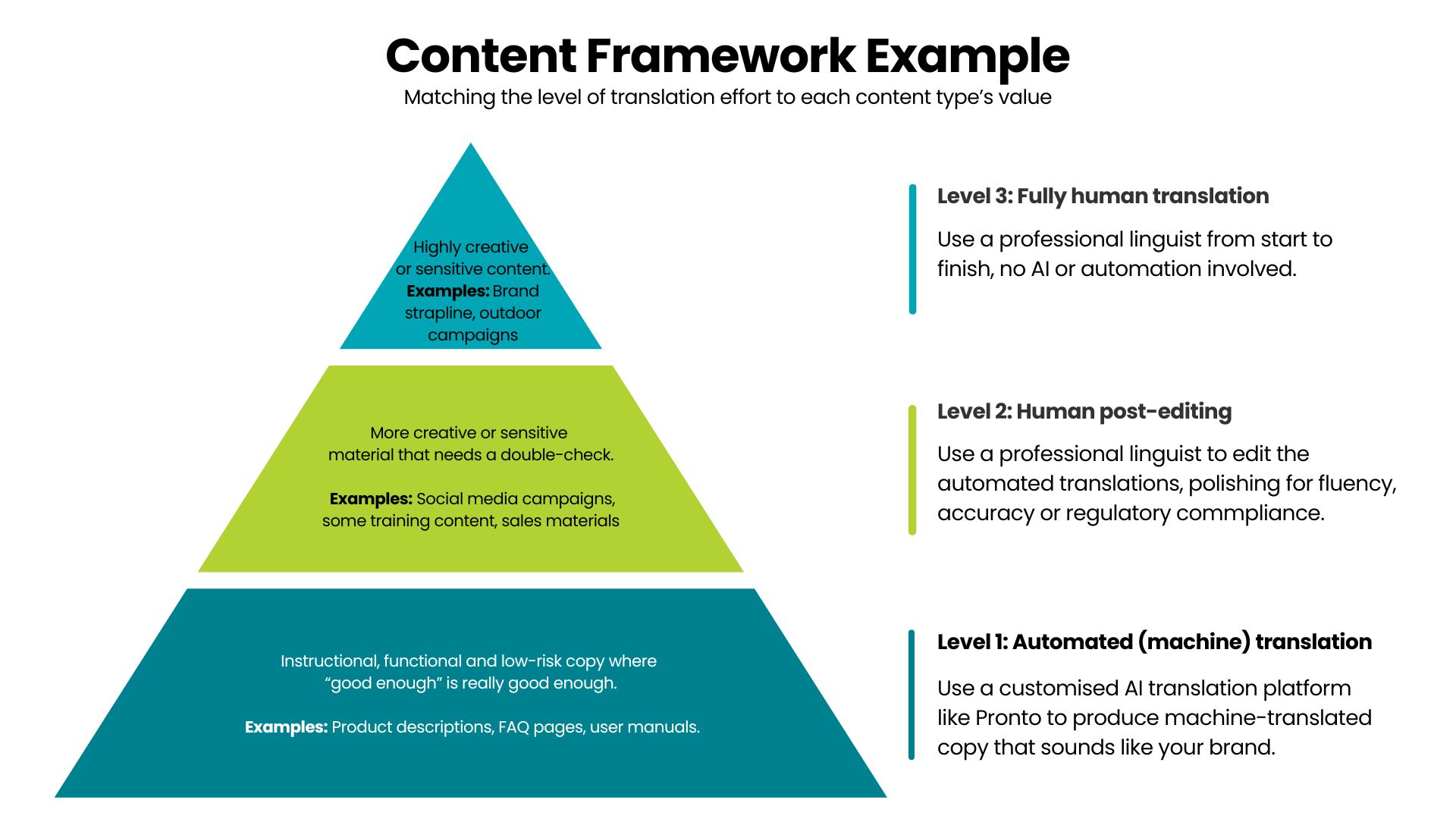
How to decide the value of a piece of content?
To help understand which content is more valuable than others to a business, we developed the Comtec Impact Matrix, a proprietary framework that categorises content based on:
- Creativity: The level of originality, cultural adaptation, and storytelling required.
- Risk sensitivity: The potential commercial, legal, or reputational impact of a mistranslation.
- Brand proximity: How critical the content is to brand perception.
- Commercial impact: The effect of the content on revenue generation, conversion rates, and customer trust.
- Audience size: The number of people who engage with the content, determining its exposure and impact.
How you apply these criteria will depend on your individual brand, project needs and ultimately, your goals. However, you can use this list as a guide and starting point to ensure you consider all the ways your content adds value.
More practical examples: How to categorise your content
Using Pronto as the example of an AI translation platform, here’s how different companies might structure their content in various scenarios.
1. A consumer brand rolling out a new seasonal campaign
- Help pages with FAQs or delivery information: Run through Pronto Auto Edit, as it’s quick, functional, and low-risk content.
- Social media posts: Add on some human post-editing to make sure that what has been automatically translated sounds on-brand and is accurate, since this is customer-facing and brand-building content.
- Evergreen brand taglines to go on an outdoor brand launch campaign: Full human transcreation, every time. When it comes to your “big spend” piece of marketing, you want to be 100% sure it’s accurate and lands with your target audience.
2. A global tech firm launching a new product
- User manuals: Auto Edit is probably sufficient, as a lot of it will be repetitive, functional and instructional content that is well suited to machine translation. You can add Pro Edit for your top five strategic markets.
- Internal training: Again, Auto Edit is good enough, since no one minds too much if a comma is out of place.
- Paid social promos: Full human translation plus local review; this might be the cornerstone of your paid campaign, and if something wasere wrong in the translation, it could be brand-damaging.
3. A pharma company launching in a new market
- Internal comms: Auto Edit, as before. Save your budget and focus on something with higher risk or reward.
- Patient-facing brochures: Human post-editing will be needed to double-check the automated translations. The information might be subject to regulations, and you don’t want to get it wrong.
- B2B sales materials: Auto Edit with human post-editing, and possibly full human translation for anything exceptionally creative, such as campaign taglines that your Sales team will use across multiple materials.
Conclusion and key takeaways
AI is brilliant, but AI without a content framework can mean wasted money and messy results.
Using a content framework plus a translation tool such as Pronto gives you scalable localisation, lower costs, faster launches, and happier teams and customers.
By taking a strategic approach to organising your content before deploying AI, you can:
- Maximise AI confidently, applying it to high-volume, lower-risk material or exploratory markets.
- Focus human expertise where it counts, for example, on brand-critical or compliance-heavy content in top-priority markets.
- Align teams across the business, so localisation decisions are transparent and consistent.
- Scale with control, investing first where it will have the most significant commercial return.
At Comtec, we’ve built Pronto to fit this exact model. We can help you:
- Audit your content and markets.
- Build categories that make sense.
- Map each category to Auto Edit, Pro Edit, or full human review.
- Set up fully connected, smooth workflows.
- Measure the savings, performance and ROI.
Want to chat more? Please get in touch, we’d love to help!