
For fast-growing UK fintechs, whether operating in cross-border payments, neobanking, RegTech, or wealth management, international expansion is rarely a slow, multi-year rollout anymore. When a new market opens up, speed to market is everything.
AI has fundamentally shifted what’s possible here. Localising product documentation, API guides, onboarding materials and help centre content can now be achieved across multiple languages far more quickly than through traditional processes alone. AI-enabled translation platforms such as Pronto help fintech teams manage large volumes of content, reduce costs and bring international launches forward.
For scale-ups under pressure to expand across Europe and beyond, those efficiency gains are impossible to ignore. AI is no longer an experiment; it’s an active engine in modern content operations.
But while the broader industry conversation remains fixated on raw speed, the most successful fintech leaders are focusing on a very different metric: confidence.
Translating content quickly only creates value if your users, regulators, and partners actually trust what they’re reading.
Speed is a feature. Trust is the foundation.
In financial technology, user experience and trust are inextricably linked. A customer rarely rates your app on how fast its interface was translated into German or Spanish. They judge you on whether your onboarding instructions are crystal clear, whether your security protocols make sense, and whether your brand feels legitimate in their local market.
If a KYC (Know Your Customer) step feels ambiguous, drop-off rates spike. If financial terminology in an API doc is translated inconsistently, developer adoption stalls. If compliance disclosures miss the mark in a new jurisdiction, the risk isn’t just poor user experience; it’s regulatory scrutiny.
AI delivers impressive momentum, but technology alone cannot guarantee accuracy, cultural context, or compliance. That assurance comes from pairing smart tools with deep linguistic expertise.
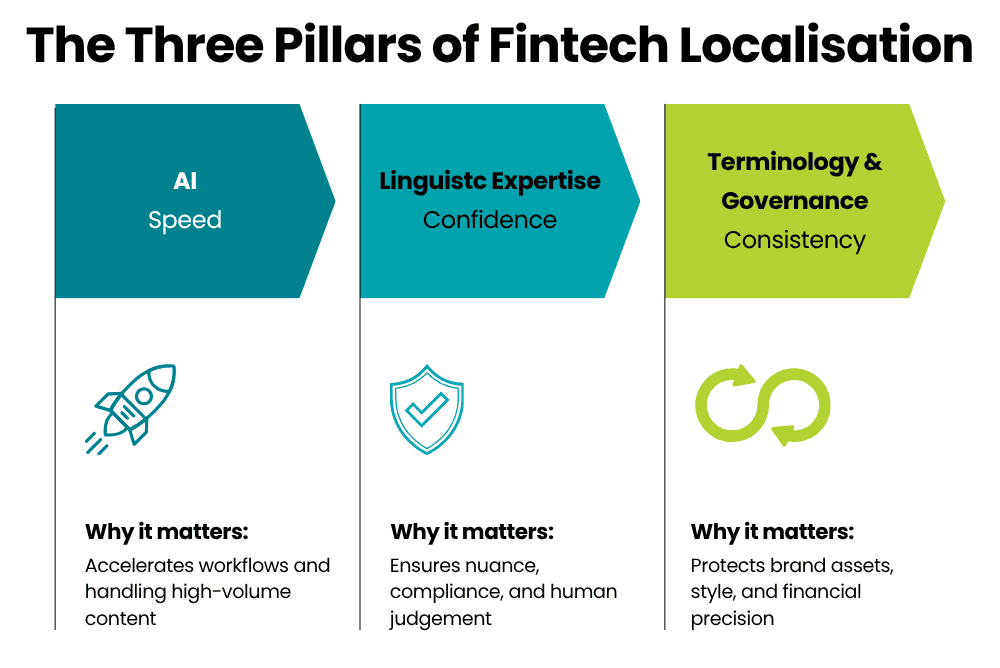
The three pillars of modern localisation
To build a scalable, high-confidence localisation workflow, fintech teams need more than a powerful translation engine. They need a combination of technology, specialist expertise and clear governance.
These three elements work together:
- AI creates speed and scale.
- Terminology and governance provide consistency.
- Linguistic expertise ensures that content communicates clearly and appropriately in every market.
Pillar one: AI provides speed and scale
AI has transformed what is possible for fintech content teams.
High volumes of product documentation, release notes, knowledge base content, API guidance and customer support materials can now be translated far more quickly than through traditional processes alone.
This makes it easier to support frequent product updates, respond to changing market requirements and make content available to international customers and partners without creating months of additional work.
But speed alone is not enough.
An AI system can process content quickly, but it does not automatically understand which terms are commercially sensitive, which product names must remain untranslated, how formal the brand should sound or when a phrase carries a specific regulatory meaning.
To produce reliable results, AI needs to operate within a translation environment configured around the organisation using it.
Pillar two: Terminology and governance create consistency
Every fintech creates its own vocabulary: proprietary feature names, microcopy, compliance phrasing, and technical concepts form the signature language of your business. That language is a core commercial asset; it builds recognition and fosters familiarity.
When you feed raw text into an unguided AI model, it has to make educated guesses. Sometimes those guesses are fine, and other times, they miss the mark:
- A proprietary feature name gets literally translated into French, losing its trademarked identity.
- A critical banking term is translated using different synonyms across two adjacent help articles, confusing the user.
- Your sharp, modern brand tone drifts into dry, bureaucratic jargon.
Individually, these look like minor editorial slips. But collectively, they create friction, erode user confidence, and dilute your brand.
That’s why mature fintechs invest as heavily in translation memories, termbases, and brand style guides as they do in the underlying AI engines. These assets provide the essential guardrails AI needs to generate consistent, high-quality output without losing what makes your business unique.
Pillar three: Linguistic expertise provides confidence
Technology can generate an initial translation, but expert linguists provide the judgement needed to determine whether it is right for its purpose.
Their role extends far beyond correcting grammar or replacing individual words. Specialist linguists help to:
- Refine and maintain financial and technical terminology.
- Protect the organisation’s tone of voice.
- Identify ambiguity or unintended changes in meaning.
- Adapt content for the expectations of local users.
- Review high-impact content where accuracy and clarity are critical.
- Feed approved corrections back into the wider translation process.
For a fintech operating internationally, this expertise is particularly important. Product, compliance and technical content often contains terminology that appears straightforward but carries a specific meaning within the business or the wider financial sector.
Expert review provides confidence that content is not only fluent, but also accurate, consistent and appropriate for the people who will use it.
The strongest localisation workflows do not treat AI and linguistic expertise as competing alternatives. They use AI to handle scale and repetition, while applying human judgement where context, nuance and risk require it.
AI translation should reduce work, not move it elsewhere
AI translation is usually introduced to save time, reduce costs and help teams manage growing volumes of multilingual content.
But without the right setup, it can simply move the workload from one part of the business to another.
Product teams may find themselves checking terminology across multiple languages. Compliance teams may feel they need to review every output because there are no clear rules about what can be trusted. Marketing teams may repeatedly correct tone of voice, while technical specialists are asked to resolve inconsistent wording in API documentation and implementation guides.
The organisation may be translating more quickly, but its internal teams are still spending significant time reviewing, correcting and approving the results.
Common challenges include:
- The same corrections are being made repeatedly because they are not captured centrally.
- Different teams using different terminology for the same product or feature.
- Uncertainty about which content can be published directly and which requires expert review.
- Specialist employees being asked to check translations without a clear process.
- High-risk and low-risk content being treated in exactly the same way.
This is where terminology management, governance and expert support make a practical difference.
Approved corrections can be added to translation memories and termbases so that the system becomes more effective over time. Clear quality thresholds can determine which content requires human review, while defined responsibilities ensure that product, marketing, compliance and localisation teams understand their role in the process.
The aim is not simply to translate content more quickly. It is to create a workflow that reduces repeated corrections, protects specialist teams’ time and gives the business confidence that the right level of oversight is being applied.
That level of oversight will not be the same for every type of content.
Not all fintech content carries the same risk profile
One of AI’s greatest strengths is flexibility. That doesn’t mean every string of text should follow the exact same path to market.
A high-volume knowledge base article that updates weekly has completely different risk and quality requirements than a core product onboarding flow or a legal T&C update.
Rather than forcing all content through a single rigid pipeline, high-performing teams tier their content based on impact and risk:
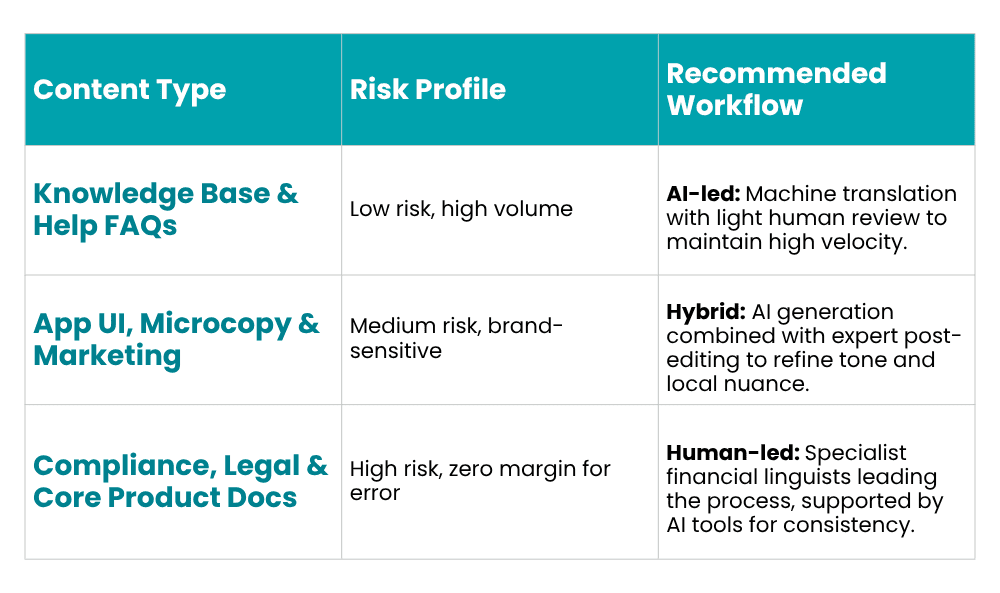
Matching the level of human oversight to the stakes of the content allows you to capture maximum efficiency gains without exposing your business to unnecessary risk.
From translators to brand custodians
As AI capability advances, the role of expert linguists isn’t disappearing; it’s evolving.
The real value of a modern localisation partner no longer lies in converting words from Language A to Language B. It lies in helping you architect a multilingual strategy that scales effortlessly as your product suite grows.
At Comtec, we view our linguists as custodians of your brand and trust. Their job is to train the underlying models, curate your financial terminology, enforce governance, and review high-stakes communications to ensure your message lands with the exact warmth, clarity, and precision intended.
Combining tech and human judgement
The future of fintech localisation isn’t an “either/or” choice between AI and human expertise. It’s about building a workflow where both do what they do best.
AI brings the speed required to launch in weeks rather than months. Human expertise provides the nuance, oversight, and cultural insight needed to earn user trust from day one.
The fintechs that win internationally won’t simply be the ones using the most technology. They’ll be the ones using AI with the greatest clarity, purpose, and commitment to quality.
Ready to scale your fintech comms internationally?
If you’re exploring how to integrate AI into your localisation workflows without risking brand trust or compliance, we’d love to help. Get in touch with the Comtec team today to discuss how we can build a tailored, high-confidence strategy for your business.