
These days, if you’re using AI, you can get translations in minutes. What takes an age, though, is reviewing them, chasing approvals and pushing them live.
Unless, like many people I talk to, you’re not doing any of that, and you’re pushing content live without properly checking it first.
It’s easy to see how this happens: if you’re using an AI tool or a plug-in that can translate, a page of text that used to take days comes back in minutes, in as many languages as you like. That’s great on the surface; it technically saves you money upfront, and for many content types, it does a decent job.
But it also makes one important job all too easy to skip: checking the translated content.
Let’s look at what should happen before you publish: how to set up your tools so they produce better versions the first time round, who should review the output, how to brief them, and what a simple but robust sign-off process should look like.
Why translations still need checking
It’s a fair challenge because, at first glance, much of the content an AI tool produces will look passable.
But here’s a simple test. Would you publish AI-written English without reading it first? Most people wouldn’t. Even in English, which makes up more than 90% of the data GPT-3 was trained on, you’ll find inaccuracies or stylistic issues you’d want to change.
Yet AI translations regularly go live without anyone checking them, either because no one on the team speaks the language or because the team has decided to trust the output and streamline the process.
When we put one of our own blog articles through AI translation into German, we spotted several things we’d change. And for a blog article, depending on the intended usage of the piece, maybe that’s acceptable. But a checkout flow? Or compliance training? Or a launch campaign? Not so much.
The truth is, in many cases where brands use AI internally, the operational translation process needs a rethink. The question shouldn’t be “Can the tool translate this OK?” but “Who decides if this is good to go?”
How to set up your translation tool properly first
Many people don’t realise how configurable most AI translation tools are, and setting them up correctly can be the most impactful step.
In our experience with our own clients, taking time to customise your AI tool before you start translating can often improve output quality by up to 20% compared to raw AI translation. But as AI translations more often than not take double the time for internal reviewers to check than fully human translations (essentially, there’s more to change!), it’s really worth taking the time to set up your tool properly.
Four things make a real difference:
- Creating and uploading a style guide for each language, covering your brand tone of voice and whether to use formal terms (“tu” versus “usted” in Spanish, for example)
- Adding a glossary of key terms and how they should be translated in each language
- A “do-not-translate” list of brand or product names
- Writing and setting the correct prompts, so your translation tool actually uses all of the above
The better your setup, the less there is to check, and your reviewers can use their time more creatively or impactfully, for example, making the content more emotionally engaging, instead of catching basic errors.
Who should review AI translations?
You have up to three options here:
- A colleague who speaks the language (ideally natively), knows the market and the product. They usually won’t be trained linguists, so the tighter your brief, the better the result.
- A translation agency. Professional linguists are hand-picked for their knowledge and experience in your languages, market, and industry. They’ll bring expertise, efficiency and consistency.
- A mix of the two, which is the best answer for many teams. You can split by language; for example, colleagues cover the languages they speak, and an agency handles the rest. Or you can split by expertise: a linguist checks language and fluency, and a colleague checks subject-matter correctness. This approach works well for more technical translations.
How to write a good reviewer brief
Many people don’t realise that briefing is a real skill. A vague “Can you check this please?” will produce a completely different result from something specific, loaded with information and parameters.
Whoever is completing your translation reviews for you, here are several tips to help you write a useful brief:
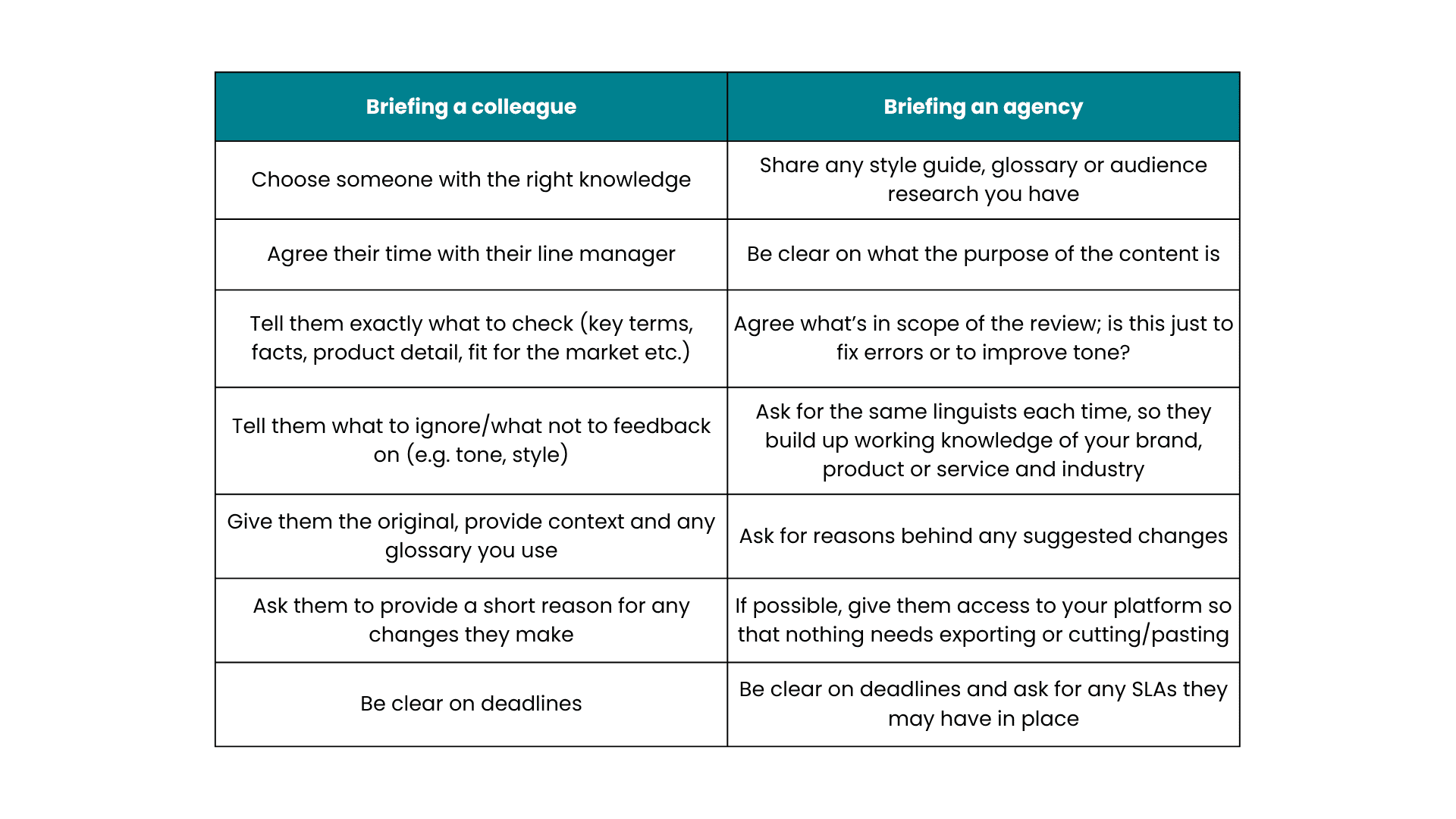
Following this process should make the reviewing and sign-off stages run much more smoothly for everyone involved.
A simple process from translation to publication
Really, the whole process comprises just five steps:
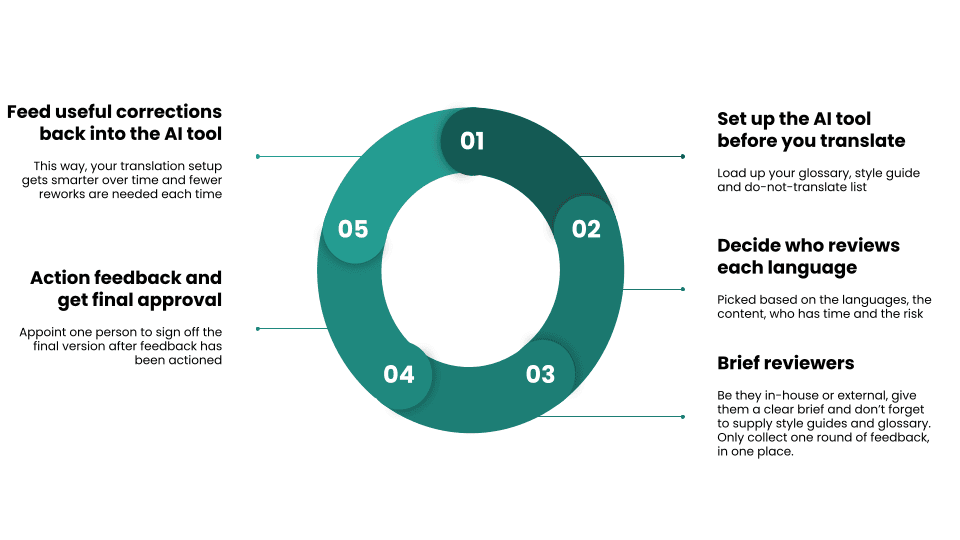
Following this process should make the reviewing and sign-off stages run much more smoothly for everyone involved.
Ready to put all this into practice?
This is the work we do with in-house teams day in, day out. We work as an extension of our clients’ teams, helping set up their tools, configure their AI translation models, and bring in professional linguists where the team’s knowledge has gaps.
How much help you need is up to you. Some teams want us to help them get more from the AI tools they already use, through our AI Optimisation service, with a glossary, a style guide and the right settings in place. Others want a secure, brand-tuned AI translation environment through Pronto, with specialist linguists on call when content matters. Others would rather hand it over completely and let our team work as a dedicated, integrated, always-on extension of theirs, via our Managed Translation service.
Whichever route suits you, you get a named team that knows your content and the right mix of AI and human expertise for each piece, so you spend less time chasing reviewers and fixing translations, and more time on your day job.
Join our upcoming webinar
I’m running a webinar on exactly this topic on Thursday, 12th Nov, 3pm GMT (10am EST). If you’d like to, please join us to go over this in more detail and get expert tips on how to make your AI translations flow to publication as seamlessly as possible. Plus, there’ll be free resources handed out live in the session.
Register here.
We can help you get projects live faster, and with fewer mistakes
You can also get in touch to talk through your setup. We’d love to help you figure out where AI can save you time and money, and how to get the most from the tools you’re already using.