
The questions clients actually put to us about AI and translation, answered by the people who do this for a living.
“Can’t we just run it through AI?” is a question we’ve heard a lot in recent years, and it deserves more than a quick yes-or-no answer.
We work with AI in localisation every day and have a firm view of our own ethos and approach, but we wanted this guide to be more than one agency’s opinion. So we put the questions our clients ask us to ten people from across the industry: five professional linguists, four marketers and content leaders, and the Chief Executive of a national language industry body. The aim was partly to pressure-test our own thinking, and partly to make sure the answers held up from every angle.
We’ve written up, in full, what they shared with us in our white paper on AI in localisation. This article is the shorter, more practical companion, built around the questions that come up most often in client conversations.
The short version
Most of the “how best to use AI” for translations comes down to matching the content to its risk level. The table below covers the cases that come up most often.
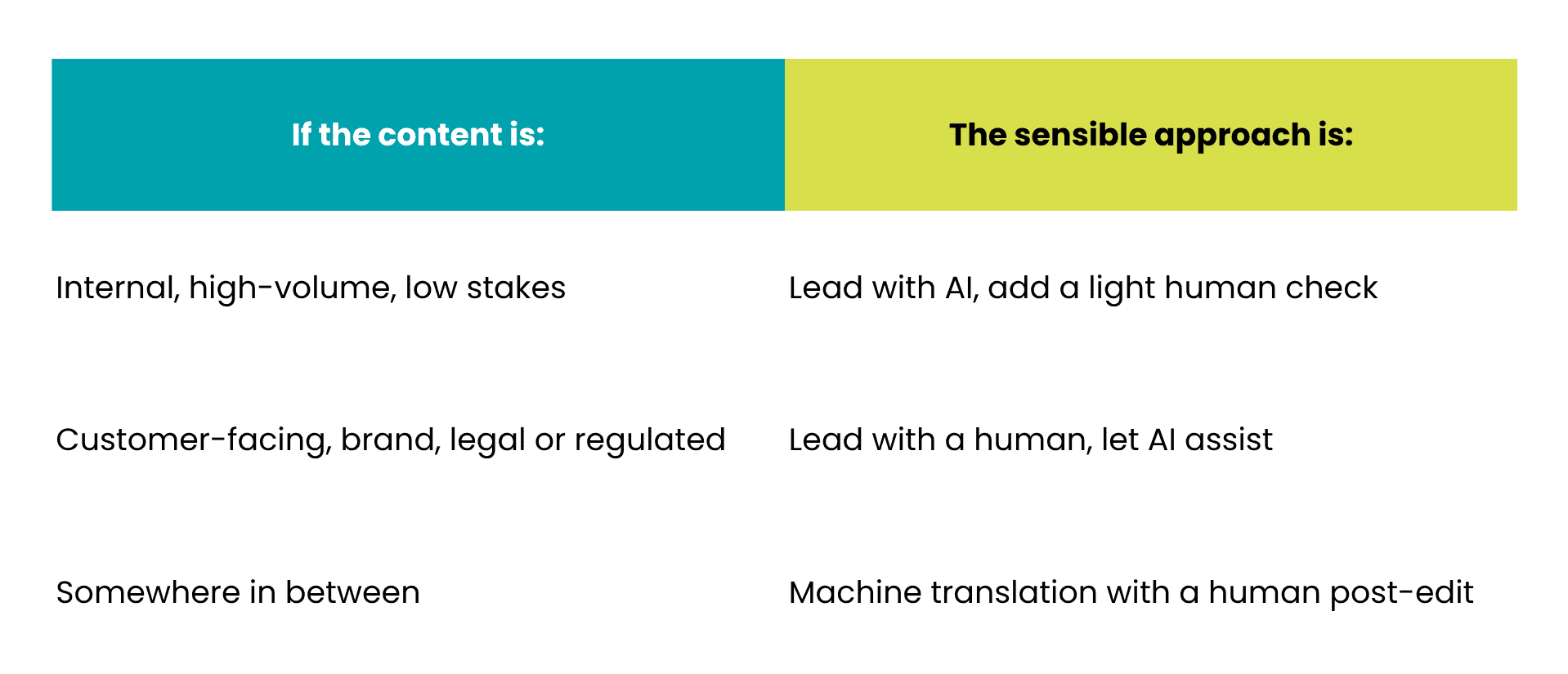
Everything else sits somewhere on that spectrum, and the rest of the content in this article should help you feel confident in making those decisions.
The big questions about AI and translation
Can I use AI to translate everything and anything?
In a word, no, though it’s worth understanding why rather than taking it on faith. AI translation is genuinely good at a great deal of localisation work, but whether it’s the right tool for a particular job comes down to three things:
What’s the content for, what’s its purpose?
- What’s the content for, what’s its purpose?
- Who’s going to read it?
- What would it cost you if it’s wrong?
When those line up in AI’s favour, it saves you real time and money. When they don’t, you risk publishing something that reads accurately, but is wrong in a subtle yet usually specific way: a straight mistranslation (think about the two meanings of a simple word like “glasses”, for example), the wrong industry term, or a tone of voice that doesn’t fit the audience. As Leighton Osbourne, who runs the SEO agency Good Yolk, puts it:
“AI is not a one-stop shop. The output is only as good as the human input.”
Leighton Osbourne, content and marketing strategist, Good Yolk
Is AI translation accurate?
It can be, and that’s exactly what makes it tricky, because accurate and inaccurate output can look identical on the page. Modern translation engines produce fluent, confident text, whether or not they’ve actually understood the source. This is where reviewers are often tripped up; the text looks so good at first glance that it’s easy to take your eye off the ball and miss things.
Zoe Makin, COO at AI integration agency Minimal Viable Launch, frames the gap nicely:
“Accurate is not the same as authentic. AI gives you “correct”, but it doesn’t give you tone, culture or brand voice.”
Zoe Makin, COO, Minimal Viable Launch
Michael Holloway, who leads SEO and content at the agency Hookflash, adds a related concern about provenance. With most AI, you can’t see where it has drawn its information from, and so he’d trust a medical journal rather more than a tabloid, treating AI as a starting point to be challenged rather than a finished source to be trusted.
Knowing when output is genuinely fit to publish is a skill in its own right, and being able to answer that question confidently will always help you make the right call. It’s why we built our Localisation Scorecard, a free tool that walks you through your own content and helps you assess it against exactly this criteria.
Will AI replace human translators?
The experts don’t think so, but they’re equally clear that the job is changing, and quite quickly. Rather than disappearing, the role is evolving, because often the work of linguists now sits further down the process, i.e. reviewing and evaluating machine output, managing terminology, advising on culture, and doing final edits.
Dilek Yigit, a freelance translator with 25 years of experience in English to Turkish, likens it to architecture. This profession has always taken up new tools to do better work rather than being replaced by them.
Zora Jackman, an award-winning translator and interpreter, highlighted the value a second pair of eyes brings right at the beginning of an AI-based project. A good linguist is often the only person who’ll catch an error in the source text itself, the wrong date or the muddled sentence that the machine would otherwise translate faithfully and send straight out the door.
So, where does AI fit in the translation process?
Where does AI translation work best?
AI is at its strongest on higher-volume, lower-risk content. Things like internal communications, first drafts, knowledge bases, product information, and large bodies of well-structured text with clear, consistent terminology.
We spoke to experts who described it as a cure for the blank page, useful for getting ideas and first drafts down quickly, and a genuinely helpful way to turn dictation into clean prose.
It’s also a time-saver when it comes to formats, for example, taking a single long-form article and turning it into audio, social posts, an email sequence and metadata, freeing you up to spend time on strategic and creative work.
And there’s also a strategic prize at play. Raisa McNab, chief executive of the Association of Translation Companies, points out that AI is letting smaller exporters reach markets that used to be out of budget, moving from translating a website and a handful of documents to localising social content and video, and even running sentiment analysis in new languages, all for the same spend.
It’s worth remembering why that matters commercially: the ATC’s own research suggests that businesses that make proper use of translation are around 30% more likely to succeed in exporting than those that don’t.
“AI is the digital junior. You stay the director and the thinker.”
Zoe Makin, COO, Minimal Viable Launch
What content still needs a human?
Anything where the tone, the nuance, or the stakes do the real work. That means marketing and brand storytelling, websites and customer-facing copy, eLearning, and anything legal, medical or regulated, where an undetected error is expensive or dangerous.
The clearest illustration came from Oliver Knaupe, who translated one of our blogs via three routes: raw machine translation, an automated post-edit, and a full human review. The original text carried a measured, professional piece of criticism, the sort of thing an English person would deliver with a raised eyebrow (rather than a raised voice).
One machine version stripped the criticism out altogether and left a bland, neutral line; the other swung too far the other way and made it openly aggressive. Only the human found the register of the original intended. Nothing had been mistranslated word for word; it was the tone that went missing, and the tone was the whole point.
You can read the full case study here.
Fernando González, a translator and language consultant with 26 years of experience, offers a cautionary tale about going “full AI.” On one project, the client switched midway to a newer, slicker engine, and the error rate went up rather than down, simply because the output looked so polished that the team trusted it and stopped reading as closely. Polished and correct are not the same thing, as he points out.
“Companies spend so much to craft a brand voice. The wrong translation approach can completely twist it.”
Oliver Knaupe, freelance translator and language consultant
How does AI translation actually work?
What is machine translation post-editing?
Machine translation post-editing, usually shortened to MTPE, is the process of a professional linguist reviewing and improving machine-generated output to ensure it’s accurate, natural, and ready for publication. It’s the workhorse of modern localisation because it offers much of the machine’s speed alongside a human-guaranteed quality. For most medium-risk content, it’s the sensible middle ground.
If you’d like a fuller explanation of how machine translation works and what each post-editing level means, you might want to check out this article.
What is automated post-editing, and how is it different?
Automated post-editing happens before a human ever sees the text. An AI layer cleans up the raw machine output, tightening terminology, consistency and phrasing, so that whatever reaches the human reviewer is already in better shape. The distinction that matters is the order of events: automated post-editing improves the draft, but it doesn’t sign it off.
At Comtec, it’s the engine behind Pronto, our self-service tool, which uses an approach we call MTAP, machine translation with automated post-editing, configured around your terminology, tone of voice and target markets rather than a generic off-the-shelf engine. Oliver’s three-way experiment above is why a human option still sits at the end: automation gets you closer, but it was the person who saved the brand.
There’s more on how that works in our guide to getting better, faster, on-brand AI translations.
Do glossaries and style guides really make a difference?
Yes! More than almost anything else you can do, and for less effort than people tend to expect.
A glossary is your agreed-upon list of key terms and their translations; a style guide captures your tone and how the brand should sound. Together, they give both the machine and the linguist the context to stay consistent and on-brand, and because a tool like Pronto can be trained on them and learn from each approved project, the benefit grows the more you translate.
If you make one inexpensive, high-impact change to how you use AI for translation, this should be it, because the context you put in directly affects the quality you get back out.
Putting it all into practice
How should we get started with using AI translation?
The first step is to categorise your content by objective, audience, and risk. Then test your workflows with real content rather than trusting a sales-pitch demo. Finally, we also recommend bringing your linguists in early, so they can point out where the process might need an extra pair of eyes.
This last step is often skipped, but plenty of the experts we spoke to said it’s wise to resist the urge to push raw AI output to a public audience without that human review stage.
Aya Lewis, an English and Japanese translator and interpreter, told us about a software platform client whose AI translation produced so many typos and wrong words that the product couldn’t launch at all. The most annoying bit? Every one of those errors would have been caught at the review stage, had a linguist been brought in early.
“Involve linguists early. If you do it later in the process, it’s going to cost you more.”
Dilek Yigit, freelance translator, 25 years’ experience
Read more on how to get properly set up for AI translation here.
How can Comtec help?
We help clients in two ways: by determining the right approach for each type of content and/or by doing the work.
On strategy, that means sitting down with your content, mapping it by risk, and designing a workflow that fits, rather than applying a single blanket rule to everything.
On delivery, we match the tool to the job: Pronto and our MTAP approach for fast, customised machine translation at volume; fully human translation and transcreation where tone and brand carry the message; and glossary, style guide, and translation memory work to keep everything consistent as you grow.
You can see the full toolkit of our translation offerings here.
Start with a conversation.
Got a project or an AI set-up you need a hand with? Just get in touch, we’d be happy to help.
Want the full picture? This Q&A is based on our expert interview series. Read the white paper: AI in localisation: what the experts really think.