
Ten linguists, marketers and industry leaders on where AI is genuinely changing their work, how they’re using it, and what businesses should do about it.
Executive summary
Over recent months, we sat down with ten experts who work with translation and global content every day. We deliberately canvassed for a range of perspectives: five are professional linguists; four are marketers, content leaders, and senior operators who reach international audiences; and one is the Chief Executive of the ATC (Association of Translation Companies), speaking for the wider industry.
We asked each of them the same broad question: what is artificial intelligence actually doing to localisation, and what should businesses make of it?
We didn’t set out to ask whether AI belongs in this work; it plainly does, and every person we spoke to already uses it. The more useful question, and the one this paper answers, is where AI adds the most value to translation, where it doesn’t meet users’ expectations, and what changes once you add it into your workflows.
The answer we’ve uncovered in this study is more interesting than the familiar headline of “humans against machines”. The experts aren’t neatly divided into believers and sceptics; in fact, they broadly agree, and what they agree on is very practical and transferable to any organisation using AI.
Five key findings keep emerging in almost every conversation:
- AI is already embedded in localisation. It’s no longer a forecast or a threat; it’s the way the work is done, now.
- Fluency is not the same as accuracy. Output can read beautifully yet still be wrong, and the failure is often invisible to the process owner.
- AI genuinely earns its place in boosting speed and reach, especially for marketers.
- Human expertise is becoming more valuable, not less, because judgment is now the scarce part of the process.
- Different content carries different risks, so it needs to be handled differently. Treating everything the same is where brand reputational damage is done.
Taken together, the picture is clear: the future of localisation is human-led and AI-enabled, with each making the other more effective. The organisations that do well will be the ones that pair the technology’s speed with an expert’s judgement, and harness AI to produce brand voices that are distinctive and globally recognisable.
The study in numbers
- 10 experts interviewed across three perspectives: professional linguists, industry leaders from marketing and content, and the chief executive of a national language industry body.
- 100+ years of combined frontline language experience among the five linguists alone.
- 100% of experts agreed that human expertise remains essential, particularly for nuanced, customer-facing and culturally sensitive content.
- 70% warned, unprompted, that fluent-sounding output can mask missing meaning, wrong terminology or distorted tone.
- 30% described themselves as former AI sceptics who have since changed their minds and now use it daily.
Figures reflect a qualitative study of ten in-depth interviews and should be read as a clear pattern of expert opinion rather than a statistical survey.
Finding 1: AI is already part of the work, not a forecast
The first thing the interviews dispel is the idea that AI in localisation is something on the horizon. It’s already arrived, and even the experienced linguists who were initially wary now use it routinely.
From a professional linguist’s perspective, Zora Jackman, who has worked in translation and interpreting for more than 30 years and remembers when source texts arrived by fax, was sceptical at first and has since come to value machine translation as a way to handle larger volumes while continuing to learn.
Dilek Yigit, who translates from English into Turkish, doubted that the technology could cope with a language so structurally different from English. Three years of steady improvement later, she runs her own machine translation experiments even when clients don’t ask her to, such is her belief that it speeds up the work.
The marketers describe the same thing. Leighton Osbourne, who runs SEO agency Good Yolk, first dismissed AI as a fad and is now a daily user and convert. The recognition drove a shift across the group: the tool is here to stay, so the question now is how to use it well.
“AI is not a one-stop shop. The output is only as good as the human input.”
Leighton Osbourne, content and marketing strategist
Finding 2: Fluent is not the same as correct
If there was a single warning this paper delivers, it’s this one. Modern AI produces text that reads fluently, and that fluency is exactly what makes its mistakes dangerous. In a nutshell, the output looks finished, so people stop checking it.
Aya Lewis, an English/Japanese translator and interpreter, describes the most insidious version of the problem. When a human translator struggles with a difficult passage, you can see it in the awkward phrasing or the hesitation. When AI struggles, it can simply omit the difficult part, with no signal that anything is missing. These types of invisible “errors” are why she regards machine translation of public-facing content without human review as a serious risk. Aya gave an example of a well-known localisation software platform whose AI translation produced so many typos, wrong words and inconsistencies that the client’s product could not be launched at all.
“Clients need to be educated. It’s not perfect yet; they need to have human input.”
Aya Lewis, freelance translator and interpreter
Oliver Knaupe, a specialist German legal translator, gave us the clearest illustration of how subtle this can be. While working on a Comtec blog post, he compared raw machine translation, machine translation with automated post-editing (MTAP), and a fully human-reviewed version of the same text. One passage carried a piece of professional criticism, expressed in the measured, idiomatic way English allows. One machine version removed the criticism entirely, leaving a flat, neutral statement. Another rendered it as openly aggressive and accusatory. Only the human found the appropriate middle ground.
The meaning was not mistranslated word-for-word; the tone was lost, and the tone was the message.
“Companies spend so much to craft a brand voice. The wrong translation approach can completely twist it.”
Oliver Knaupe, freelance translator and language consultant
Michael Holloway, who leads SEO and content strategy at digital agency Hookflash, says that he treats AI as a challenger rather than a finished source. He’s also wary of the black box problem of not knowing where a model has drawn its information, saying he would trust a medical journal over a tabloid; it’s important to know where AI is pulling from before he trusts it.
Similarly, social media consultant Ally McDonald Alonso notes that the very speed that makes AI useful is also what makes it quick to get things wrong.
“Speed is brilliant. AI can be really quick, but it’s so quick to make a mistake.”
Ally McDonald Alonso, Founder of APHM, a social marketing agency
Zoe Makin, COO at AI integration agency Minimal Viable Launch, puts her finger on something anyone who works in translation already knows. Accurate and authentic are not the same thing. AI will give you the “correct” text, but it tends to miss the tone, the cultural read, and the brand voice that determine whether a message actually lands.
Worse, it tends to flatter. Makin calls this the “congruency cascade”, the way AI behaves as a yes man, agreeing with whatever it is given rather than offering a genuine, critical challenge. The danger compounds with what she calls the “illusion of quality”, where an expert sees at once that an output is only surface deep, while a non-expert reads the same text as impressive. Fluency, in other words, fools the people least able to check it.
“Accurate is not the same as authentic. AI gives you the “correct”. It does not give you tone, culture or brand voice.”
Zoe Makin, Chief Operating Officer
Finding 3: AI adds most value when it comes to speed and scale
The experts fully agree on where AI delivers real value: it’s strongest for speed, content repurposing, and reach, particularly for marketing content.
Here is what the experts we spoke to had to say about using AI in their daily jobs:
- Leighton (Good Yolk SEO agency) says he uses AI to turn a single long-form article into audio narration, social snippets, an email sequence, and SEO metadata, and to automate project management so he can spend his time on the creative and strategic parts.
- Ally (social media consultant) values it as a cure for the blank page, a springboard for ideas and first drafts, and, as someone with dyslexia, a way to turn dictation into polished prose.
- Michael (Hookflash digital marketing agency) uses it to stress-test briefs and to find an angle quickly in an unfamiliar sector.
- Raisa McNab, chief executive of the Association of Translation Companies, makes the most strategic case. The real prize, she argues, is not cost saving but expansion. Through her work with the Department for Business and Trade, she has watched exporters who could once only afford to translate a website and a few regulatory documents gain access to social media localisation, audiovisual content, sentiment analysis and hyper-local market intelligence.
- Zoe, whose work focuses on AI integration, uses a simple framework she calls the 10-80-10 method. The first 10% is done by a human; you set the brief, the context, the direction. The AI takes the middle 80% and produces a first draft. Then the human comes back for the final 10%, the part where you make sure the output is genuinely good and sounds like the brand, rather than a machine. The discipline lies in never skipping that last 10%.
The conclusion seems to be that AI, used thoughtfully alongside human oversight, enables businesses to do far more with their multilingual content than was ever financially or technically possible before.
“AI is the digital junior. You stay the director and the thinker.”
Zoe Makin, Chief Operating Officer
Finding 4: Human expertise is becoming more valuable, not less
The counterintuitive finding is that AI doesn’t diminish the value of human linguists; it concentrates it. As the machine handles more of the volume, the human contribution shifts to the parts that are hardest to automate, namely judgment, cultural understanding, terminology and risk awareness. That work actually becomes more valuable, not less.
Professional Czech translator Zora Jackman points to a role that is easy to overlook – a skilled human reviewer catches errors in the source text itself. She regularly finds logical inconsistencies, wrong dates and unclear meaning in client-submitted content, often AI-generated or recycled, which the machine then translates faithfully without ever flagging the problem.
The human translator effectively becomes a second pair of eyes, protecting the client from publishing a mistake they did not know they had made.
“A human linguist can help with consistency, spot errors in source text, and act as a second pair of eyes.”
Zora Jackman, award-winning translator and interpreter
Several linguists describe their own profession evolving rather than disappearing. Dilek Yigit compares it to architecture, a field that has always adopted new tools to do the job better, and expects linguists to act increasingly as quality supervisors.
Professional specialist translator Oliver Knaupe believes the per-word translation model is unsustainable in the long run and sees the future in roles such as evaluating machine output, orchestrating different engines and providing the right context to the machine in the first place.
Fernando González speaks to the value of real, hard-won, lived experience, which as a translator, means catching the sort of errors that pop up frequently. On one of his projects, a client switched to a newer, better-looking machine translation engine partway through, and error rates actually rose, because the polished-looking output lulled the team into trusting it and reviewing less carefully.
Zoe Makin of MVP makes the same case from the client side: AI is a pattern-recognition machine, so creativity, originality, and the empathy required for customer and crisis communication have to remain human-led.
Finding 5: Not all content carries the same risk
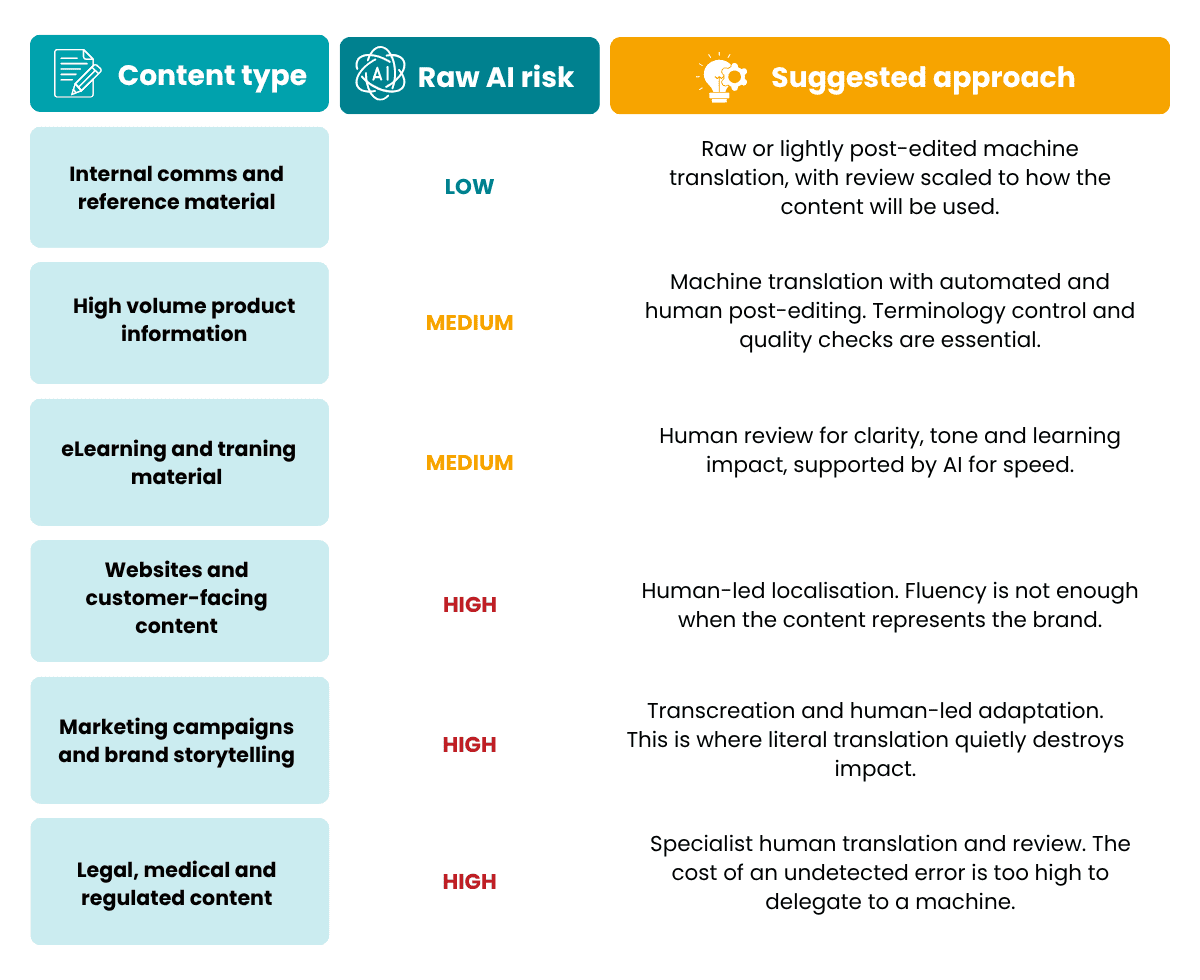
One conclusion the experts keep returning to is that AI shouldn’t be used indiscriminately; the choice of “AI or human?” depends on the content’s purpose, audience and risk.
Internal comms and high-volume, well-structured material with clear terminology are natural candidates for heavy automation. On the other hand, brand storytelling, eLearning and anything legal, medical or regulated, demand human judgment, for two solid reasons:
- The cost of getting it wrong is high
- The value of the content lies in the nuance of the messaging
The following framework summarises the consensus and offers a starting point for deciding how to handle a given piece of content.
AI Translation Framework
Industry perspective: The linguist relationship is part of the process
A theme that surfaced repeatedly, and one that matters more than it first appears, is the relationship between the linguists and the companies they work with. Several interviewees expressed enthusiasm bordering on surprise about being consulted at all, which tells you how rare it is.
Professional Spanish translator Fernando González was the most direct about why it matters.
“We are not resources. We are key for you (localisation service providers), and you are key for us.”
Fernando González, freelance translator and language consultant with 26 years’ experience
Treating linguists as interchangeable resources strips out exactly the judgment that now creates the value. The experts who felt trusted and well briefed produced better work and said as much. Dilek Yigit’s advice points in the same direction and has direct commercial logic.
“Involve linguists early. If you do it later in the process, it’s going to cost you more.”
Dilek Yigit, freelance translator, 25 years’ experience
What this means for your business
The interviews translate into a short, practical set of actions for any organisation that uses or considers AI in its multilingual content.
- Audit your content by risk before anything else. Sort it by purpose, audience and the cost of getting it wrong. This single step determines everything that follows.
- Match the workflow to the content; don’t use a blanket AI policy. Use automation where it is safe and human-led localisation where the brand, learner or law is on the line.
- Never publish raw AI output to a public audience without passing it through a human review stage. Fluent and finished are not the same as good, and the “illusion of quality” problem is hard to spot.
- Invest early in glossaries, style guides and source-text quality. The context you give the machine is the single biggest lever on the quality you get back.
- Bring linguists in at the start, not the end. This improves quality, protects your brand voice, and, as the experts note, costs less than fixing problems later.
Conclusion: human-led, AI-enabled
For all the noise about disruption, the people who do this work for a living are remarkably aligned. We can all agree that AI is a genuine advancement, in that it accelerates work and, because your budget goes further than before, it opens up markets or opportunities for translation that were previously out of reach.
But, it’s also fluent in a way that hides its own mistakes, indifferent to nuance, and only ever as good as the human input and oversight around it.
The future the experts describe is not human or AI. It is human and AI, with clear processes and real quality checks.
Commercial edges do lie in AI, more than one expert we spoke to warned of homogenisation; if every brand leans on the same models trained on the same data, global content starts to sound the same.
The opportunity for brands here is to keep investing in a distinctive, intentionally localised voice, and those that do will stand out. The competitive edge will belong to the organisations that make those decisions early on as part of a wider growth strategy, and keep expert judgement at the centre of the process rather than at its edge.
“Find a language services partner who is transparent and capable of putting together the solutions you need.”
Raisa McNab, CEO, Association of Translation Companies
How Comtec can help
If you’re working out how AI fits into your localisation, Comtec can help you assess your content, identify the right workflow for each type, and build a safe, scalable approach that protects quality and brand voice.
We pair expert linguists with the right level of technology for the job, from machine translation and automated post-editing through to fully human translation and transcreation.
Start with a conversation. Talk to us about a content audit, and we’ll show you where AI can save you time and where human expertise will save you from a costly mistake.
About this study: this paper draws on a series of in-depth interviews conducted by James Brown at Comtec with professional linguists, marketers and industry leaders during 2026. Quotations are used with the speaker’s permission and were lightly edited for clarity.