
After 40 years in business as a translation agency, we’ve helped create and launch more localisation programmes than we can count, from scrappy exporters looking to translate a website to global retail brands looking for full automation and integration.
We’ve noticed that the strategies that work all share five key principles. When you action them, cost stops ballooning, brand voice stops drifting, and launches stop slipping.
So here are those five cornerstones to successful localisation, complete with checklists and shortcuts, to help you get the most from your time and effort spent on creating multilingual content.
Tip 1: Categorise your content
One of our most-used phrases with our clients is “Not all content is created equal”.
What we mean by this is that some content is going to be more commercially important to your business than other, so rather than having a one-size-fits-all solution to how you approach translation, it’s more ROI efficient to match your investment to the value of the content.
We always recommend splitting your content by the visibility and impact of potential errors as the first step. Then you can decide how much human craft vs. automation each bucket deserves.
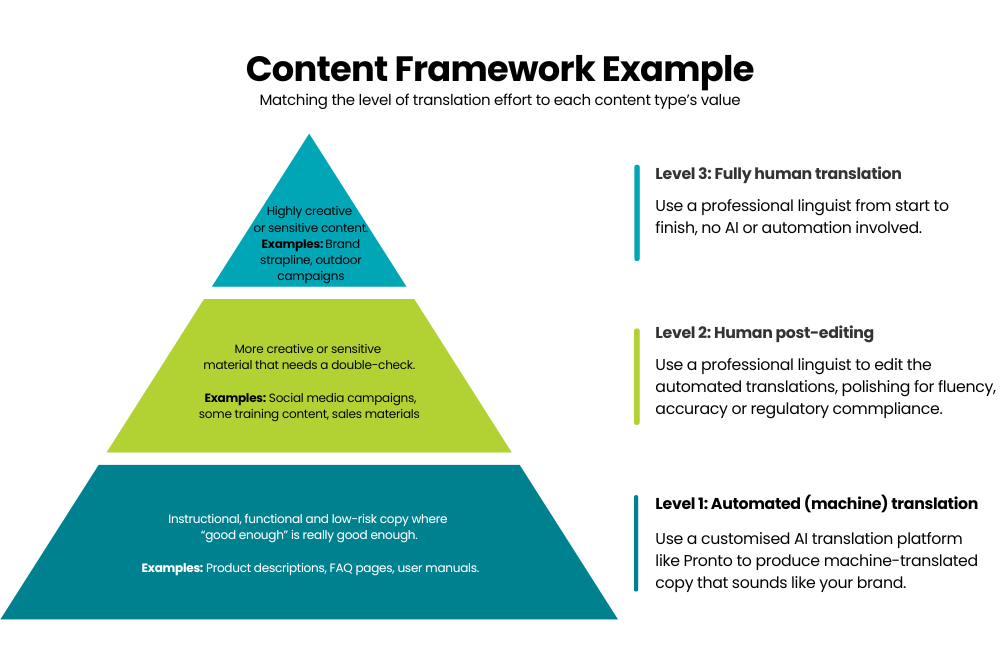
Think in three tiers:
- Level 1 (low-risk/operational): Long-tail UGC, bulk FAQs, internal documents or low-risk training content. For this type of content, it’s safe to lean on AI translation with light checks (but strong model training using terminology guides).
- Level 2 (medium): Product pages, CRM journeys, highly trafficked customer service pages. Here, we’d recommend using a combination of automation (machine translation) with human post-editing. We call this MTPE (machine translation + human post-editing, and it’s a great hybrid option when time and budget are tight.
- Level 3 (high-stakes): Brand ads, hero pages, paid campaigns, investor comms, sensitive or regulated HR/L&D/Marketing. These things demand expert human adaptation (transcreation) or translation.
Check out our FREE content framework.
Tip 2: Mix your translation methods
Trust us, there’s no single “best” method. What’s best for your setup is probably going to be a blend of approaches for each category identified above.
There are, however, three core approaches:
- Fully automated: This is AI translation plus automated (AI-based) post-editing. We call this MTAP (machine translation plus automated post-editing), and you have the option of fully outsourcing it or using a tool like Pronto to bring the whole process in-house.
Read about the pros and cons of bringing localisation in-house.
✅ Pros: Fast, cheap, effective.
❎ Cons: Lower accuracy; we would never recommend a fully automated approach for sensitive content or anything regulated or compliance-based.
- Hybrid (AI with human post-editing): This is our MTPE solution, which combines the speed of AI translation with a linguist’s judgement on tone and clarity.
✅ Pros: Faster than human methods, cheaper than fully human methods.
❎ Cons: Any AI tool is only as good as the linguist who sets it up. Lots of brands are tempted to cut time on setup, but it’s the most critical stage of all. Drafting the style guides, terminology library, and prompts for fluency can make all the difference between slop and something that approaches human-created quality.
- Fully human translation/transcreation: This is best saved for your Level 3 content, where the creative intent or accuracy comes first. You’re paying for a super-qualified expert’s experience in research, understanding cultural nuance or market-specific rules and regulations.
✅ Pros: Without a doubt, the highest-quality and most accurate translation method money can buy.
❎ Cons: As it’s completely manual, it’s difficult to scale (although blended with a hybrid approach, you could set editing rules in an AI tool, having first consulted a linguist).
Tip 3: Pick the right translation technology to scale
How do you scale localisation in a cost-effective, secure and strategic way?
If you don’t, teams can go “rogue”, using publicly available translation tools that aren’t safe. Did you know, for example, that every time someone in your organisation uses a free tool like Google Translate, whatever content is uploaded there can be saved to their cloud history?

Using free translation tools exposes your organisation to data breaches.
To keep your content safe and secure, we recommend using tools like Pronto that adhere to strict controls (for example, no data is retained for training, and it’s fully GDPR compliant). It’s also the safest way to scale while remaining consistent – one tool that the whole business uses means you can set style guides and approved terminology that everyone will use in every instance.
Tip 4: Connect your workflows to speed everything up
It amazes me that in this day and age, so many teams are still using cut-and-paste.
It’s terrible practice for lots of reasons:
- High risk of human error
- Slow
- Poor use of your time
- Error-fixing can be a nightmare
- It’s really difficult to manually fix something in a different alphabet (e.g. Korean or Arabic)
It’s much more effective to connect your CMS, LMS, PIM, eCommerce platform etc., to your localisation platform so that the content flows automatically with the right memories, glossaries and no versioning headaches.
Generally, teams that add connectors cut manual steps, see lower error rates and faster roll-outs.
Tip 5: Keep working at it; great localisation processes continuously improve
Often, we have to educate our clients that localisation isn’t a one-off project; it’s never really “finished”. It’s better to think of it as a process, an operation within your organisation. AI settings, glossaries, workflows, fluency and efficiencies should all improve over time if organisations build in feedback loops.
Examples of optimisation in action:
- Continuous feedback: Collecting input from in-market reviewers and end users.
- Glossary updates: Adding new terminology as products or services evolve.
- AI refinement: Tuning machine translation engines based on past outputs.
- Performance monitoring: Tracking cost savings, turnaround times, and quality scores to identify areas of improvement.
This ongoing cycle ensures that localisation not only meets current needs, but becomes more efficient and accurate year after year.

Like any business operation, localisation isn’t a “set it and forget it” task. You’ll get better ROI over time if you regularly iterate, tweaking things as you go.
How to know if you’re doing it right? Our top 5 KPIs to track
If you follow these five tips, you should see improvements in several key areas of your business.
To make it really simple, here’s a checklist of five KPIs we like to use with our clients to see what’s working and what needs more attention:
- Coverage: Aim for the 80/20 rule; try to localise the 20% of pages that likely drive 80% of your traffic per market.
- Speed: Track the median production time (in days) from source to published per market. As a benchmark, using AI should reduce turnaround times by 50%-80%.
- Efficiency: Look at your average cost per 1k words quarter over quarter (or year over year if you’re implementing big changes that take a long time to roll out).
- Impact: This will be individual for each business, but look at things like app sessions, conversions, repeat sales by customer and support resolution time by language vs. the English baseline.
- Quality/risk: You can measure this in terms of complaints, returns, claims awarded etc., whatever makes most sense for your organisation. But pick a metric that can be compared to your English baseline to measure how well (or poorly) the messaging is landing in your non-English markets.
How can Comtec help?
At Comtec, we’ve been supporting global organisations for over 40 years. Today, we combine this deep localisation expertise with cutting-edge AI solutions like Pronto alongside secure integrations and human-led services.
Our goal is simple: to help you deliver more content, in more languages, faster, without losing sight of brand, quality, or security.
Want a quick evaluation of your current setup? We can run a 30-minute assessment against the five cornerstones and leave you with a concrete 90-day plan. Use the link below to contact us. We’d be delighted to help out!