
If you’re working in a creative agency and translation still feels like something that complicates projects rather than adds value, you’re not alone. It’s one of the most common things I hear from agency teams, and it’s also one of the biggest missed opportunities I see.
I’m James, Head of Commercial at Comtec, and I’ve spent 14 years partnering with creative agencies on global campaigns, working with teams at Dentsu, Brainlabs, PMG, McCann, TMS and many more. I recently ran a webinar for agency teams on how to make localisation easier to sell, easier to manage and more commercially rewarding. This article pulls together the key insights from that session.
The thread running through all of it is this: When agencies bring translation into the conversation early, good things tend to follow. They win more global briefs, grow their accounts, and become the kind of strategic partner clients want to keep working with.
Here’s a debrief of what I’ve seen work well.
Translation is a commercial opportunity, not a production headache
Global campaigns are the standard now, not the exception. But the way you bring them to market can go one of two ways: it either quietly bleeds your margins dry or becomes a genuine commercial edge.
The biggest mistake I see? Treating translation as an afterthought. Too many agencies under-scope it, under-sell it, or, worst of all, simply swallow the cost in their own budgets.
On the other hand, what I’ve consistently seen is that agencies that bring localisation into the conversation earlier tend to win more global briefs, increase scope, retain clients longer, and gradually shift from being campaign delivery partners to long-term strategic partners.
What holds agencies back?
A scenario I hear all the time is: the campaign has landed, the client loves it, and then someone says, “Great! Now we need another 10 to 15 markets.“
Suddenly, there are concerns about brand dilution or the tone not landing. Local teams get involved late in the process and start rewriting instead of reviewing. Feedback loops multiply, timelines slip, nobody’s happy and worst of all, nobody feels confident about how to price or scope any of it.
Localisation shouldn’t feel like you’re constantly playing catch-up. Most teams aren’t failing; they’re just lacking the framework to lead. We want to help you flip that script, moving from reactive fire-fighting to a streamlined, proactive partnership.
Finding a localisation partner that works for agencies
Let’s be honest – not all translation companies understand agency life.
The best partnerships I’ve seen tend to form when your localisation partner:
✅ Works with other agencies and already understands the pace, pressure, and client dynamics.
✅ They have relevant industry experience with brands like yours, bringing sector-specific knowledge from day one.
✅ Takes onboarding seriously, investing upfront in glossaries, style guides and specialist linguist teams tailored to each client.
✅ Offers flexibility rather than forcing a one-size-fits-all process onto every campaign.
Localisation works best when you define the strategy together rather than handing it off as a task.
Not all content needs the same translation approach
I keep returning to this point in conversations with agencies and in-house clients alike. It’s the one idea that truly changes how people think about their translation strategy.
Every piece of content carries a different level of value, risk and impact. A global campaign tagline and a help centre FAQ play completely different roles, so treating them identically wastes money on the low-impact content and under-invests where quality actually shapes customer perception.
We use something called a Localisation ROI Framework to help agencies categorise content before choosing a localisation approach. The framework helps you evaluate each content type against creativity, risk, brand proximity, commercial impact, and practical constraints such as budget and deadlines.
The result is that you move from selling your clients “translation” as an add-on product or service to selling them a localisation strategy, and that puts you in a much stronger commercial position.
Three tiers of translation: Matching effort to value
Once you’ve categorised the content, you match each category to the right approach. At Comtec, we use a three-tier model:
Tier 3: Fully human-led translation. Save this for your highest-impact content: campaign messaging, taglines, hero copy, a client’s website. For some content at this level, you might need transcreation, where linguists recreate the message with full creative freedom in the target language.
Tier 2: Machine translation with linguist post-editing (MTPE). A hybrid approach that suits the bulk of day-to-day marketing content: product pages, campaign variants, email marketing, and case studies. AI handles the initial translation, and a linguist refines every sentence for fluency, tone and accuracy.
Tier 1: Machine translation with automated post-editing (MTAP). Works well for high-volume, lower-risk content: help centre articles, FAQs, internal updates, and less-trafficked parts of your mobile app. Unlike raw machine translation, MTAP uses a customised engine configured by linguists with your client’s approved terminology, tone of voice and translation memory before any content is processed. That means brand rules are built into the system upfront, reducing inconsistency and rework while maintaining speed.
And don’t worry, agencies don’t need to make these decisions alone. The best outcomes I’ve seen come from situations where the agency, the localisation partner and the client all align on what approach suits each content type.
Selling translation with confidence
I want our agency partners to feel completely at home discussing translation strategy. As AI shifts the landscape and content volumes skyrocket, your clients need more than just ‘words’ – they need a plan.
Here are the most common questions and objections, along with how I’d suggest addressing them.
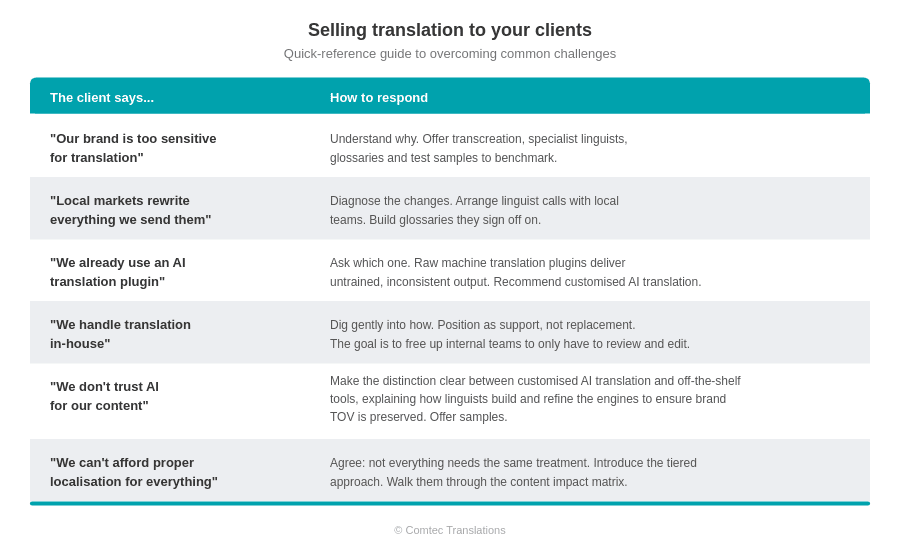
1. “Our brand is too sensitive for translation”
Start by asking what’s behind that concern. Nine times out of ten, it comes from a bad experience with a previous provider or from seeing poor-quality translations that performed badly in a particular market.
The way to address it is with specifics on the process. Explain that you’ll assign specialist linguists who are both native speakers based in each market and hand-picked for projects based on their personal industry experience. Offer to produce test samples so they can judge the quality for themselves before committing.
For brands where the creative tone really needs to sing in every language, transcreation is usually the better option, giving linguists the freedom to adapt the message rather than translate it word-for-word.
2. “Local markets rewrite everything”
The best way to fix this is to collaborate upfront: get linguists on calls with local teams and build glossaries that local markets actually sign off on. When everyone works from the same style guide and the translators understand local preferences from the start, the rewriting stops.
3. “We already use a translation plugin”
Ask what plugin they use and whether the output reflects their brand’s terminology and style. In most cases, raw machine translation plugins deliver untrained, inconsistent output that requires heavy rework. Customised machine translation through your agency, supported by your localisation partner, can retain the speed and cost savings while protecting quality.
4. “We handle translation in-house”
That might work perfectly for them. But it’s worth gently exploring how they manage it and whether they face any capacity or quality challenges. If they do, position your agency as support rather than a replacement. The goal is to free up internal teams, meaning they only have to review and edit rather than translate themselves.
5. “We don’t trust AI for our content”
A good localisation partner will set up a specialist translation team for each language, build glossaries and style guides, and establish a translation memory that stores every approved translation for future refinement.
One thing I always recommend is to arrange calls between the linguists and the client’s local market teams. When translators speak directly with local reviewers in their own language, they pick up nuances that get lost in email chains. These calls save significant rework later.
6. “We can’t afford proper localisation for everything”
A common one! Start by aligning your client’s goals with their budget: walk through a tool like our Localisation ROI Framework to see which content actually drives revenue. Once you’ve categorised the content, you can match each “tier” to the appropriate service level and even request samples of each technique.
Seeing the difference between a “polished” campaign and a “functional” product description makes it much easier to commit to the right investment.
How offering translation can help agencies grow
Agencies that bring localisation into client conversations early and work with a strong partner tend to see real commercial benefits:
- A broader client portfolio, winning global briefs and attracting multinational clients.
- Higher average campaign value by adding markets to every engagement.
- Stronger retainers, by becoming a long-term strategic partner rather than just a campaign supplier.
- Less delivery friction, by reducing the firefighting that drains time and margin.
- Better-protected margin, by matching the right localisation approach to each content type.
The pattern I see consistently is that the agencies who feel most confident with global campaigns are the ones who bring localisation into the conversation early. When it’s planned rather than bolted on, teams have more control over scope, budget and timelines, and the commercial outcomes tend to follow.