
AI-led machine translation is a game-changer. Used well, it can deliver significant benefits for businesses, faster turnaround times, lower costs, and the ability to scale multilingual content in ways that simply weren’t practical a few years ago.
And if you’re wondering whether other organisations are already using AI for translation, the short answer is yes. According to the industry think tank Nimdzi, around 70% of enterprise localisation programmes now incorporate AI in some form. But most teams are still applying it wrong, using off-the-shelf tools that get the job done, but leave money on the table when it comes to protecting your brand in new markets.
That’s why we built the Localisation Scorecard: a structured, free diagnostic tool that helps you match your translation investment to actual business impact.
This article explains the thinking behind the scorecard, how it works, and how to get it.
First, a quick clarification: what do we mean by “AI translation”?
When we talk about AI translation, we’re referring to machine translation as the core technology, combined with different levels of human involvement.
In practice, AI never operates in isolation. Even in the most automated workflows, human linguistic expertise shapes the terminology, tone, training data, and quality rules that govern how the technology performs.
In reality, this creates a range of localisation approaches, not a single solution:
- More AI-driven workflows, where automated post-editing combines with machine translation to handle low-risk, high-volume content.
- Hybrid approaches, where professional linguists post-edit machine translation output to balance efficiency and quality, protecting your brand and making sure no embarrassing blunders slip through the net.
- Fully human-led translation and transcreation, used where nuance, cultural adaptation or regulatory precision really matters. This is copywriting directly into another language, and should be saved for brand or risk-critical projects.
The problem today isn’t a lack of tools. It’s a lack of a coherent strategy.
The hidden cost of treating all translation content the same
Consider a typical multinational: last week, they translated a compliance policy, a product landing page, three help centre articles, a CEO’s keynote address for the EMEA team, and 14 product descriptions.
All content went through the same workflow, the same rate was applied, and everything received the same level of human oversight (or lack of it).
From what I hear, this is how most organisations still operate, and while it might feel efficient to have a single translation process, it isn’t.
The compliance policy probably needed a qualified human translator to catch regulatory nuance. The CEO’s keynote almost certainly did. But the help centre articles? AI could have handled those with automated post-editing at a fraction of the cost (the most popular hybrid solution we offer, called MTAP). Depending on how visible they are, the product descriptions need only light human review.
One workflow for everything sounds efficient, but it rarely is. You end up overpaying for low-stakes content and underpaying on the pages that actually convert, build trust, or carry legal weight.
How to categorise your content before AI translation for maximum ROI
At Comtec, we’ve spent the past two years developing what we call a Localisation Scorecard: a structured approach to matching translation investment to actual business impact. It works by examining content through three distinct lenses.
The first is content characteristics. We like to say “Not all content is created equal”. What we mean by that is that different pieces of messaging carry different weight; for example, a regulatory disclosure carries legal risk that a social media caption doesn’t. The scorecard looks at visibility, brand sensitivity, risk exposure, volume, and proximity to revenue. A piece of content that touches three of these factors might warrant full human translation, while one that touches none might be ideally suited to an AI-led approach.
The second lens is the strategic value of your market. Your highest-priority markets have earned more investment than the ones you’re still figuring out. A region where you’re actively competing for credibility against local players needs sharper, more carefully considered translation than a market you’re still testing – same content, different stakes.
The third lens is language suitability, the factor most often overlooked in AI discussions. Machine translation does not perform equally well across all language pairs; high-resource language pairs like English-to-German or French-to-Spanish work exceptionally well with AI-led workflows. But lower-resource languages, or those with greater structural distance from English, such as English-to-Mandarin, will have a higher error rate.
How our Localisation Scorecard can help you invest effectively
Having analysed the value of your content, we recommend that our clients use a tiered approach, matching translation effort (and expense) to the value of the copy.
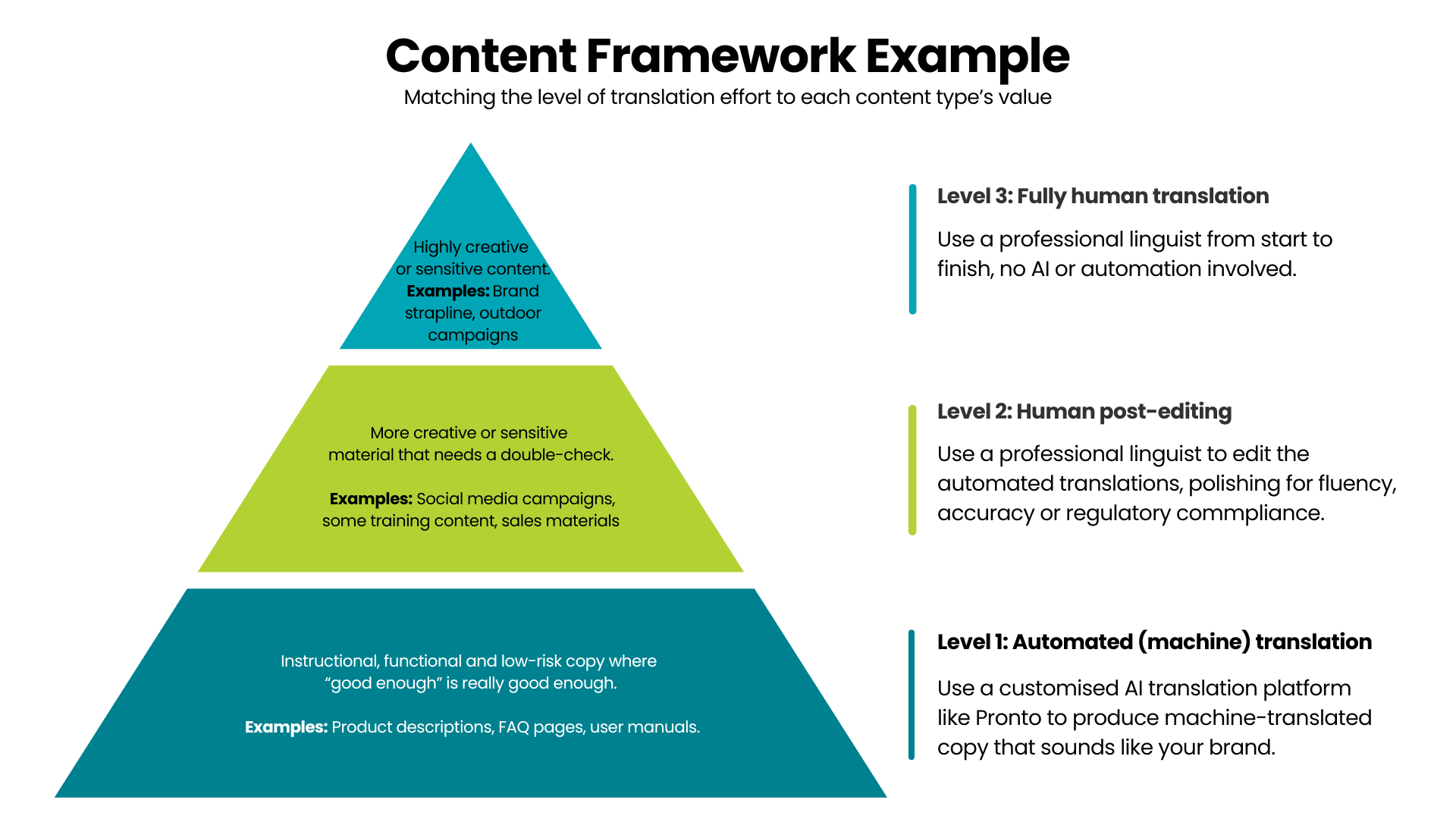
Level 1: AI Translation with Automated Post-Editing (MTAP)
Speed defines this tier. Internal comms, FAQs, knowledge base articles, product updates; basically, content where getting it out fast matters more than getting it perfect.
You still get human expertise, but it happens at the setup stage, where a linguist with real-world experience in your industry sets terminology lists, language configuration, and quality rules to guide the AI. Once that groundwork is in place, the workflow handles itself.
Level 2: AI Translation with Human Post-Editing (MTPE)
Slightly more complex content, such as CRM campaign copy, technical manuals, eLearning content, and help documentation, needs to be right, but it doesn’t need to win any awards. AI handles the bulk of the work, then a qualified linguist reviews it for accuracy, terminology, and tone. It’s become the go-to middle ground for a reason: Nimdzi’s 2025 research shows that MTPE adoption jumped from 26% to 46% of enterprise programmes in just two years.
Level 3: Expert Human Translation and Transcreation
Some content you just can’t afford to get wrong. Brand campaigns, product launches, legal documents, anything where the wrong word in the wrong market costs you real money or real credibility. Specialist linguists do 100% of the work here; no AI does a first pass. Just experienced humans who understand the language, the culture, and what you’re actually trying to say.
5 reasons to use a translation ROI framework
Teams that use our Localisation Scorecard typically benefit in five ways:
- They get a clear content matrix: an understanding of which assets need which translation method, and why.
- Their brand is better protected in new and emerging markets. They’re not leaving how they’re perceived purely to AI algorithms; experts have helped catch embarrassing or expensive blunders.
- They have a clear view of their priority markets, rather than treating everything and everywhere the same.
- They get clarity on specific languages, seeing where it’s safe to use AI-led workflows and where we’d still strongly recommend a more traditional human-led approach.
- They can make investment decisions (beyond just translation) with greater confidence. The report of your results can be applied to marketing to spend more broadly; where does it make sense to invest vs. save?
Once you have the framework, the operational decisions become straightforward.
Some teams hand the whole workflow to a language partner like us, sending files and getting back finished, formatted translations ready to publish. Others prefer to keep it in-house, using platforms like Pronto to run MTAP and MTPE workflows themselves.
For organisations that need complete automation, integration via connectors that plug in directly to CMS, PIM, or LMS platforms eliminates manual handoffs.
The point isn’t to prescribe a single approach. It’s to ensure the approach matches the content, the market, and the language.
Want to try the Localisation Scorecard for yourself?
You can access the scorecard in two ways:
Option 1: Download it for free here. Fill in this form, and we’ll email you the link to the tool. The whole exercise won’t take more than 10 minutes and will give you a good sense of what your ideal translation setup should look like. Once you get your results, you can book a call with us to discuss things in more depth or get a full quote.
Option 2: Work through it with us. Book a free session, usually 45-60 minutes, and we’ll dig into your content portfolio, market priorities, and language mix together. You’ll leave with a clear framework and real recommendations you can actually use, no strings attached. Contact us here to grab a slot.
Final thoughts on machine translation
The goal here is not to use more or less machine translation. It is about applying the right level of human involvement where it genuinely makes a difference, and taking a more strategic view of where and how automation fits.
Machine translation will only become more capable, but capability is not the same as judgment. An MT engine doesn’t know that your brand sounds confident in English but aggressive in German, or that a product name carries an unfortunate meaning in Brazilian Portuguese. It can’t tell you when a translation is technically correct but tonally off, the kind of subtle miss that makes an audience instinctively treat you as a “foreign” brand rather than a local one.
That is where expert oversight matters, and where partnering with a language expert adds real value. The organisations that get the most from machine translation are not those that adopt it fastest; they’re those that pair it with people who understand how a brand should sound in each market, who spot the gaps that automation cannot see, and who know when good enough actually isn’t good enough.
We see our role as exactly that: the strategic layer between your content and your audience. We help you move faster where it is safe to do so, and we protect your brand voice where it is not.