
In the world of SaaS, speed is everything. We talk about “agility” and “efficiency” as the metrics that matter most. But when it comes to going global, many teams hit a wall.
As your product scales, the volume of content explodes. You aren’t just translating a UI anymore; you’re managing help centre articles, constant release notes, product tours, and technical docs. Studies have shown that more data has been created, captured, and replicated in the last 3 years than in the entire history of humanity.
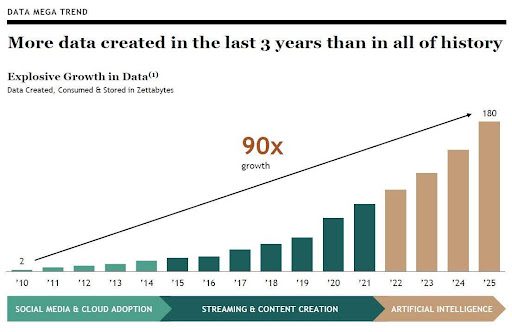
Image credit: Blackstone
For SaaS companies expanding into multiple markets, localisation quickly becomes a bottleneck. Managing translation across fast-moving release cycles, multiple content types and growing language volumes requires a different approach to traditional translation. This article shares practical tips for building a scalable SaaS localisation strategy using automation, AI and human expertise.
More content = more translation demands
According to CSA Research, 76% of online shoppers prefer to buy products with information in their own language.
For SaaS companies, this means localisation isn’t just a “nice-to-have”; it’s a prerequisite for early market penetration and, in turn, ROI-positive results from your international efforts.
In practice, when releases are still phased by geography (for example EMEA, APAC or ROW), it becomes much harder to keep pace with global competitors. And if parts of your translation process are still manual — such as copying text into spreadsheets or chasing approvals by email — your translated language versions are very likely to fall behind your SaaS release cycle.
As I mentioned in our recent webinar:
“Rapid growth means more to translate every month… manual processes simply can’t keep up. Inconsistent terminology creates user confusion and erodes the trust you’ve worked so hard to build.”
If this sounds familiar, here are my top six tips for scaling SaaS localisation safely, quickly, and cost-effectively.
Tip 1: Learn the effort vs impact rule
Trust me; not all content is created equal.
One of the most common challenges SaaS teams face is treating all content the same, for example, applying identical workflows to legal text, UI copy and low-priority knowledge base articles in the name of efficiency.
In reality, scaling effectively means matching translation effort to content impact. Some content requires close human attention, while other content can be safely automated without compromising quality.
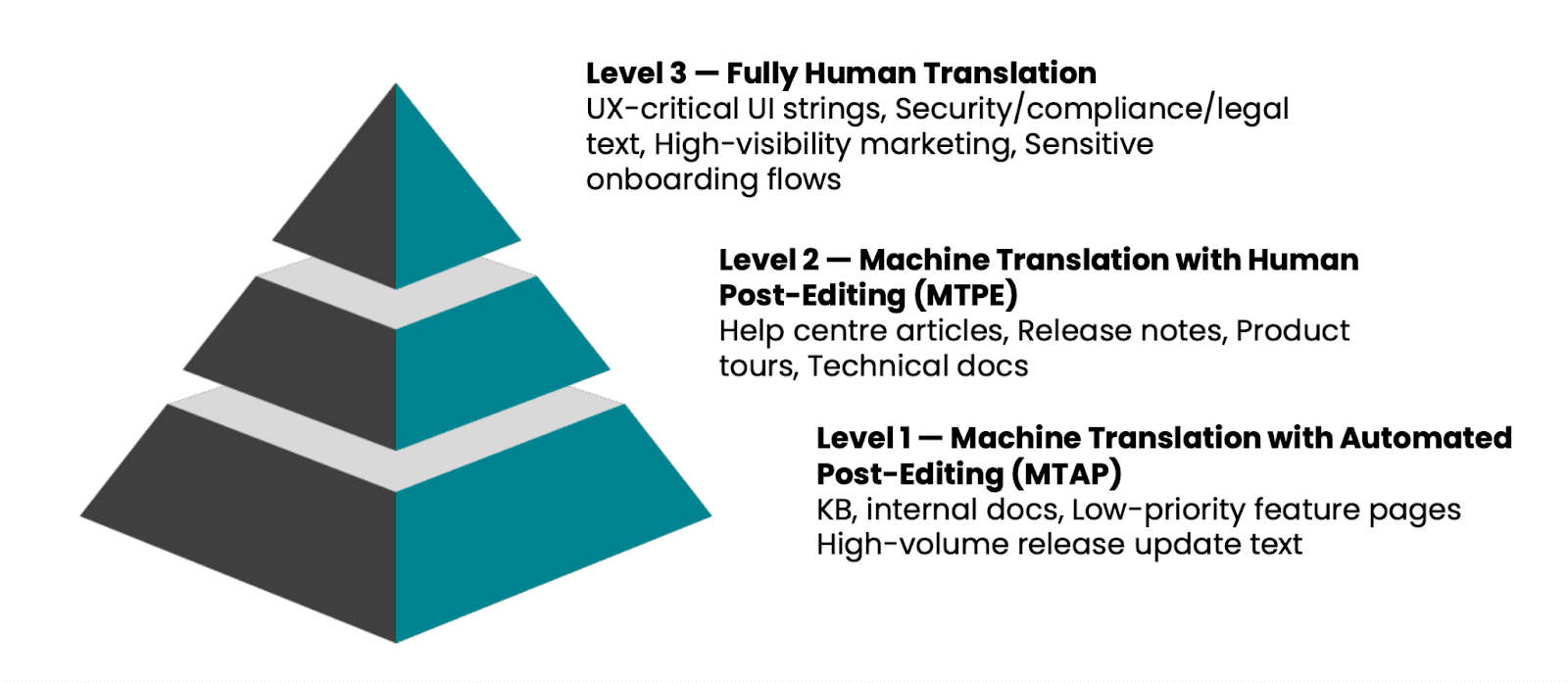
In the webinar session, I shared a Content Categorisation Framework that breaks content into three levels:
- Level 3 (Fully human translation): This is your VIP content. Think high-visibility marketing copy, UX-critical UI, and legal docs. Quality and brand voice are non-negotiable here, and professional linguists need to be overseeing everything.
- Level 2 (MTPE): For help centres and product tours, Machine Translation with Human Post-Editing (MTPE) offers a 40% cost saving while ensuring clarity and technical accuracy. It’s a halfway house that uses human linguists to finetune automated output.
- Level 1 (MTAP): For internal docs or vast knowledge bases, Machine Translation with Automated Post-editing (MTAP) can deliver significant cost-saving and faster delivery times than traditional methods. This is the fully automated option, and with tools like our Pronto platform, the AI is fully customised to your brand, so the quality is much higher than off-the-shelf options.
Here’s a brief clip from the webinar where I explain this a bit more:
Tip 2: Reduce manual handling through automation
Manual handling is one of the biggest barriers to scaling localisation in SaaS.
What we typically see is that teams lose days of productivity every month through exporting files, copying content between tools and manually coordinating reviews. These steps don’t add value, but they do slow everything down.
Modern translation technology uses connectors and APIs to link your CMS (such as Contentful, Zendesk, or HubSpot) directly to the translation environment. This creates a fully automated workflow in which new English content is automatically detected, sent for translation, and then fed back into the relevant software once ready. We call this Comtec Connect, and as I explained during the webinar:
“Connectors remove all that manual exporting and uploading. It means you can respond and get your multilingual variation in the best possible way, at the speed your product requires.”
Tip 3: Protect product terminology across your SaaS localisation workflow
Consistency is the foundation of end-user trust. If a button is called “Settings” in your English UI but translates to “Options” in your help centre, you create unnecessary friction.
Using terminology management tools ensures that your approved feature names and UI labels are automatically applied across all languages. This is vital because, as the think tank Nimdzi noted in a key report last year, consistency in technical terminology is one of the top factors in user satisfaction with digital products. It keeps your brand voice unified and reduces the “rework” loop with your linguists.
Tip 4: Use AI with clear guardrails and human oversight
AI can dramatically speed up translation, but only when it’s used with care and clear boundaries.
One of the biggest risks we see with AI-led localisation isn’t the technology itself, but how it’s implemented. When AI is treated as a plug-and-play solution, teams often end up fixing problems after the fact: inconsistent terminology, unclear phrasing, or content that technically works but doesn’t feel right to users.
High-performing SaaS teams take a different approach. They put guardrails in place and involve linguists upstream — shaping how the system behaves, rather than relying on humans to clean up the output later.
In practice, this means:
- Defining which content types can be safely automated and which require human review
- Embedding approved terminology, tone of voice and style rules into the AI workflow
- Using automated checks to flag issues early, before content reaches users
- Having linguists train, monitor and refine the system over time — not just post-edit individual files
When linguists are involved at the system level, AI becomes a reliable accelerator rather than a risk. You move faster and stay in control — protecting product clarity, brand consistency and user trust as you scale.
Tip 5: Build localisation into your release cycle
Localisation is often treated as an afterthought once a development sprint is complete, something we regularly see when teams first start scaling internationally.
Once you automate the way content flows through your process (the full automation option we discussed earlier), your translated content can stay aligned with your software releases and content updates.
The goal here is what we call “continuous localisation”; as soon as a feature is ready in English, the multilingual versions are triggered. This ensures your global users aren’t waiting weeks for updates that your UK, US or AUS users already have.
Tip 6: Start with a small proof of concept
As tempting as it is to do everything right now, we don’t recommend overhauling your entire global strategy overnight.
A small proof of concept allows teams to test workflows, review quality, fine-tune terminology and understand how automation fits into their existing processes. This might involve a single content stream or one or two target languages.
We’ve found that companies that start with a POC like this see a much smoother transition when scaling to 10+ languages because they’ve already ironed out the technical kinks in the automation loop.
Summing up
Scaling your SaaS product globally is a massive achievement, but it shouldn’t come at the cost of your team’s sanity or your product’s release velocity. By categorising your content, embracing automation, and protecting your terminology, you can turn localisation from a bottleneck into a competitive advantage.
Would you like to see the full framework? I’d be happy to share the full webinar deck, which includes a visual breakdown of the “Impact vs. Effort” matrix and the automation workflows discussed in this article.
If you’d like the slides or are interested in a complimentary review of your current localisation workflow, simply drop me an email at showe@comtectranslations.com. We’re kicking off the year with exciting new projects in the SaaS industry and would love to share our best-practice ideas with you and your team!