
If you’ve ever tried machine translation (MT) on your content and came away feeling a bit underwhelmed, you’re not alone. It’s one of the most common things I hear from the brands and agencies I work with, and it was actually the starting point for a webinar I ran recently on this exact topic.
The session was called “Making AI-driven machine translation work in the real world,” and it turned into a really honest conversation about where MT works, where it falls short, and what the teams that get strong results tend to do differently. I wanted to pull the key takeaways together into an article, because a lot of the takeaways came down to the same core idea: it’s not really about the technology. It’s about how you set it up.
SPECIAL OFFER: If you’d like to try what I’m about to describe on your own content, we’re offering a free one-month trial of Pronto, our self-service translation platform, so you can see how it works in practice with no strings attached.
The mistake that trips most teams up
Here’s a scenario that might sound familiar. You decide to explore machine translation, pick a tool, and start running your content through it. All of your content. The homepage copy, the internal HR update, the product descriptions, and the compliance documents. Everything goes through the same process, gets the same level of review (or sometimes no review at all), and the output across the board ends up looking… fine, but not great.
And that’s where the frustration tends to come from. To be clear, there’s not an issue with the technology per se, but it’s just not the optimal solution for all your content.
When you think about it, a homepage headline and UI text in your mobile app are fundamentally different things. They have different levels of brand sensitivity, commercial stakes, and audience expectations. Treating them identically usually means you’re overspending on things that don’t need much attention and under-investing in the places where quality and nuance genuinely matter.
We recommend starting with the content, not the tool
Getting this right changes everything, and I recommend starting here.
Before you choose a translation method or even look at tools, it really helps to take a step back and understand your content properly. What types of content are you translating? How creative is each piece? How visible is it? What happens if the tone is slightly off, or a key term ends up wrong?
At Comtec, we work through this with our clients using a Content Impact Matrix. It’s a fairly straightforward collaborative exercise where we take each type of content and score it against a set of criteria: how creative it is, the level of risk involved, how close it sits to the brand, its commercial impact, the size of the audience, and practical constraints like budget and deadlines.
Next, match the translation effort to the reward
What comes out of this exercise is a really clear picture of which content needs the most human attention and which can safely be handled by AI; and once you have that picture, the decisions about how to translate each type almost make themselves.
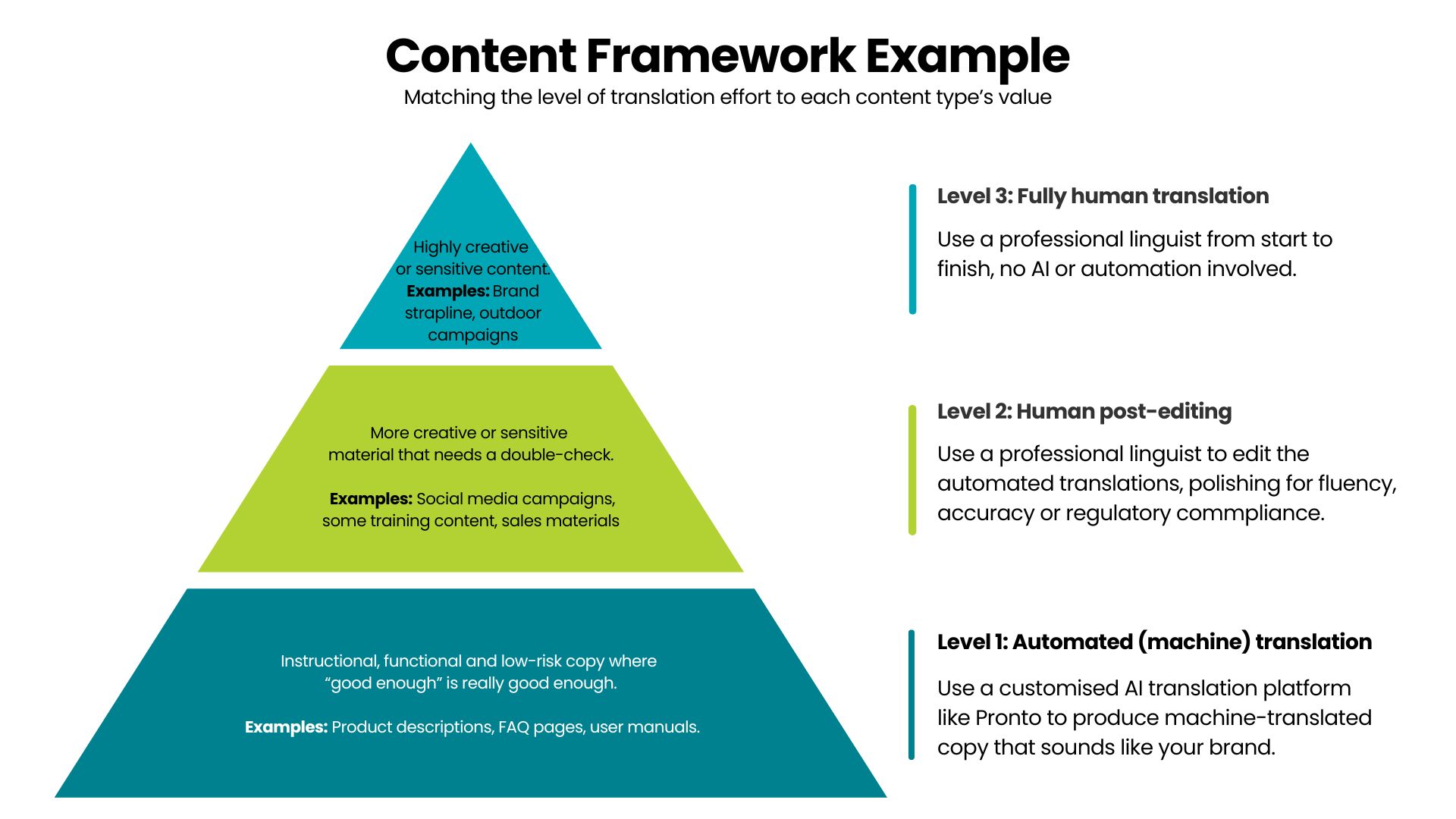
- For the highest-impact content, things like brand straplines, above-the-line campaigns and compliance checks, you want a professional linguist handling everything from start to finish. For some of this content, you might need transcreation, in which a linguist recreates your message with full creative freedom in the target language, rather than translating it word-for-word.
- For the middle ground, your day-to-day marketing content, such as product pages, email campaigns, and social copy, a hybrid approach works really well. AI handles the initial draft, and a professional linguist polishes for fluency, accuracy and tone.
- And for the high-volume, lower-risk content that every organisation produces in abundance – things like internal communications, FAQ pages, training materials and support documentation – this is where machine translation can genuinely shine. But only when you’ve set it up properly, which brings us to the part that matters most.
What a “good” installation of a translation tool actually looks like
Without that groundwork, you’re asking a generic AI to guess what your brand sounds like. It’s like hiring a copywriter and not giving them a brief. They might produce something decent, but it won’t sound like you, and you’ll end up spending more time correcting it than you saved by not briefing them properly in the first place.
At Comtec, the technology we’ve built around this principle is called MTAP, which stands for Machine Translation with Automated Post-editing. It’s the engine behind Pronto, our self-service translation platform, and it works by combining three technologies in one seamless workflow.
First, a customised machine translation engine translates your content using your translation memory and a bespoke glossary of your approved terminology. So from the very first draft, the output already uses your brand’s established terms and phrasing, putting it well ahead of what you’d get from a generic tool.
Then, a large language model refines the wording through automated post-editing. This step fine-tunes the translation to match your brand voice and the target market’s linguistic preferences. It can be customised per language, which is important because what sounds natural in French is quite different from what works in German or Japanese.
And then, for content that benefits from an extra pair of eyes, anything customer-facing or brand-sensitive, you have the option to either assign colleagues to review translations directly within Pronto, or request expert post-editing from Comtec’s professional linguists.
The really important point is that every edit feeds back into the system. Terminology gets refined, translation memory grows, and the automated post-editing rules improve. So quality doesn’t just stay consistent; it gets better the more you use it.
Why Pronto delivers better-quality translations from the start
I know there are a lot of translation tools on the market at the moment, and it can feel overwhelming trying to work out which one is right for you. But if there’s one thing I’d want you to take away from this article, the tool itself matters far less than the approach behind it.
Many self-service translation platforms rely on raw, unedited machine translation. They’ll give you output in seconds, which is impressive, but it won’t reflect your brand terminology, match your tone of voice, or improve over time because there’s no structured feedback loop.
Pronto is different because it’s been built and configured by a translation company that truly understands language. Our linguists and localisation engineers set it up specifically for each client. We train the engine, build the glossaries, configure the automated post-editing rules, and test samples until the output meets the required quality threshold. So you get the speed and cost advantages of a self-service tool, but with the quality foundations that come from proper linguistic expertise.
It also means you’re never on your own with it. If a piece of content needs more polish than the automated workflow can deliver, you can upgrade to human post-editing (called MTPE) within the same platform. There’s no need to switch tools or start a separate process. Everything stays in one place.
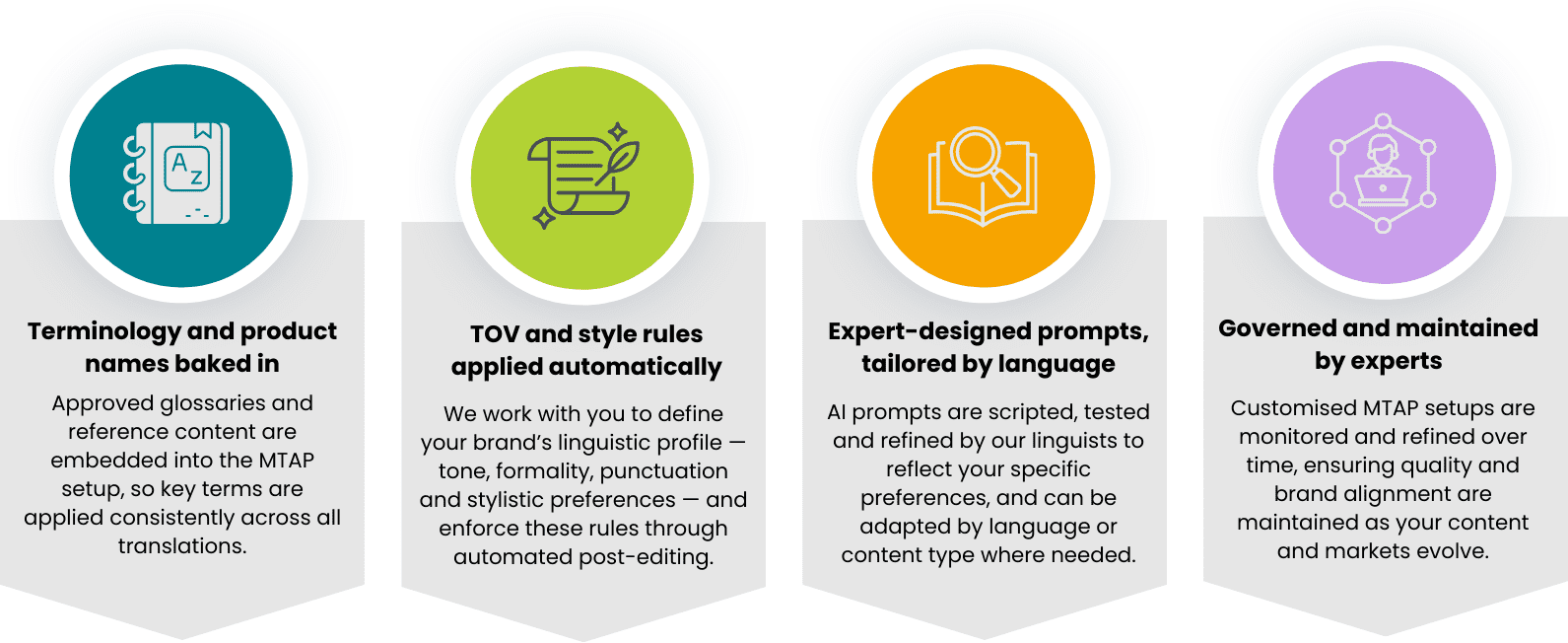
How and why Pronto beats other machine translation tools available today.
What this looks like in practice: A real-world example
The most effective localisation strategies I see combine two or three approaches rather than picking one method and applying it to everything. It’s about matching the right method to the right content type, and then making sure the whole thing runs smoothly.
To give you a concrete example, we work with a European SaaS company in the construction technology space. They have multiple content streams with very different levels of commercial value, along with specific turnaround requirements and budgets for each.
Their solution was to use Pronto for internal communications and low-risk documentation, a managed translation service for their marketing content requiring transcreation and multiple rounds of stakeholder input, and an integrated workflow for continuous website localisation. The result is that their budget goes to the content that matters most, they have a fast and reliable solution for day-to-day needs, and they have a scalable process that grows with them as they expand into new markets.
And the numbers across our client base bear this out. When brands take this kind of structured approach, we typically see cost savings of around 25% through smarter content tiering, time-to-market improvements of up to 40%, and a 30% reduction in post-editing time.
Where to go from here?
If any of this has resonated, there are a couple of practical next steps.
- Map your opportunity.
Our Localisation ROI Framework is a structured session in which we sit down with you to help you categorise your content, assess risk and impact, and identify where AI-led translation could deliver meaningful cost and time savings. It gives you clarity and evidence before you make any operational changes, and it’s completely free.
- Try Pronto for a month.
We’ll configure it to match your terminology and tone of voice for up to two target languages so that you can test a structured, brand-aware machine translation workflow on your own content. No obligation, no commitment.
Start your free one-month Pronto trial →
Or if you’d rather just have a chat about it first, drop me a line at jbrown@comtectranslations.com. I’m always happy to discuss what might work for your team.