
What the fastest-growing retail brands do differently
If you manage content across multiple markets for a retail or eCommerce brand, you already know the pressure. More products, more languages, more campaigns, more updates. And usually, the same team and budget you had two years ago.
The fastest-growing retail brands aren’t just translating more content. They’re making smarter decisions about what to localise, how to localise it, and where to invest human expertise versus automation.
Because when localisation is treated as a purely operational task, costs rise, and brand consistency starts to slip. But when it’s treated as a strategic lever, it becomes a driver of conversion, trust and long-term growth in every market.
I’m Emma, part of the Commercial team at Comtec. Together with Sophie Howe, our CEO, I recently hosted a webinar for retail and eCommerce teams on how to scale multilingual content without losing control of quality, brand voice or costs.
This article pulls together the key insights we shared. Whether you’re just starting to translate content for international markets or trying to get a better grip on a process that’s already underway, I hope you’ll find something here that makes your life a little easier.
Retail Translation vs Localisation: Why the difference matters for eCommerce brands
Here’s something I see regularly: retail teams talk about “translation” when what they actually need is localisation.
Translation is part of localisation, but it’s only one piece. Localisation is really about how customers experience your content in a different market. It includes language, tone of voice, terminology, cultural context, and the overall feeling your brand creates in that language.
That distinction matters because poor localisation doesn’t just sound a bit off; it can be confusing. It can undermine customer trust and directly affect conversion rates. When your checkout page feels clunky in French, or your homepage messaging sounds robotic in German, customers notice. It’ll be similar to when you spot AI-written copy, which makes you lose interest (and trust) quickly.
So when we talk about localisation, we’re really asking: how does your brand show up locally? And how consistent and credible does that experience feel across every market you operate in?
The volume problem is bigger than most teams realise
We’re living through a content explosion. We’ve created more content in the last three years than in the whole of human history. Retailers are right in the thick of that trend: more SKUs, more markets, more frequent campaign cycles, and product content that needs updating constantly.
Here’s where a one-size-fits-all approach to localisation starts to buckle. When you’re treating your homepage hero copy and your size guide FAQs with the same translation workflow, something has to give. Either costs spiral, turnaround times stretch, or quality drops where it matters most.
That’s where content categorisation can make you feel more in control. It simplifies decision-making, helping you focus your efforts where they matter most and reducing overwhelm and uncertainty.
Content categorisation: The foundation of a smart retail localisation strategy
Content categorisation is a simple idea with a big impact. At its core, it’s this: not all content shapes the customer experience in the same way, so not all content should receive the same level of localisation investment.
When working with retail clients, we typically help them implement content categorisation by analysing four key factors: brand sensitivity, market profile, proximity to revenue, and risk, to fit their current workflows. This structured approach makes it easier to prioritise and allocate resources effectively, ensuring your localisation efforts are targeted and efficient.
Brand sensitivity. A homepage campaign or hero message shapes how customers feel about your brand. Translating an internal policy document or a help centre article is very different.
Market profile. Is this content aimed at a core market where expectations are well established, or a newer territory where you’re still learning what works?
Proximity to revenue. Product detail pages and app checkout flows sit much closer to conversion than a size guide or a returns policy. The risk profile is different.
Risk. A social media caption that’s slightly off is worlds apart from a mistranslation in a regulatory disclosure or legally sensitive content.
The trick is matching effort to reward, which also boosts your ROI. Without that, you risk overspending on less impactful content and neglecting high-value areas.
A tiered approach to retail localisation: The practical bit
Once you’ve categorised your content, the next step is to match each tier to the appropriate localisation approach. We find it helpful to think of this as a pyramid.
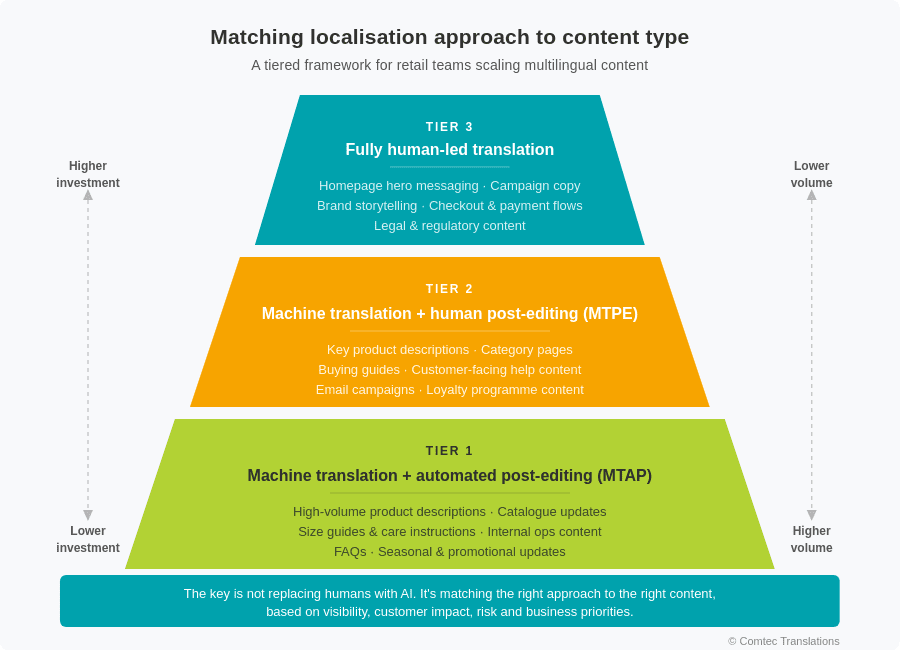
Tier 3: Fully human-led localisation. Save this for your highest-impact content: —homepage and campaign messaging, brand storytelling, checkout and payment copy, anything legally sensitive. The investment is higher here because the impact on customer experience and trust is greatest. For some content at this level, you might also need transcreation, where linguists aren’t just translating words, but recreating the message with full creative freedom in the target language.
Tier 2: Machine translation with human post-editing. A hybrid approach works well for content that still matters to customers, but doesn’t carry the same level of brand or legal risk. Think key product descriptions, category pages, buying guides, or Help Centre content. AI handles the initial translation, and a linguist reviews and refines the output to ensure clarity, accuracy and consistency. It’s where most retail teams find the sweet spot between efficiency and quality, especially as content volumes grow.
Tier 1: Machine translation with automated post-editing. We call this MTAP, and it’s an approach we developed specifically for high-volume, fast-moving content. Large product catalogues, frequent seasonal updates, size guides, care instructions, and internal operations content. Rather than raw machine translation, which treats all content the same and knows nothing about your brand, MTAP is configured by linguists before it starts. They embed your approved terminology, tone of voice, style rules and market preferences into the system, so the output stays on-brand even at scale.
We explore each of these approaches, including MTAP, MTPE and human-led localisation, in more depth in our retail guide. Download the guide here.
Language doesn’t just describe products, it gives them value.
Before we wrapped up the webinar, I shared some research we’ve recently done at Comtec into how luxury and high-street brands use language very differently. Not just different words, but different logic.
We found that for luxury brands, the actual vocabulary used is very different; for example, a high-street brand might say “product,” but in the luxury world, it’s a “creation.” We also found that the use of foreign loanwords is higher for luxury brands (think Atelier or Maison), and these are exactly the things that would trip up a generic AI translation engine.
Because LLMs prioritise the “most likely” word choice, they tend to strip away the nuance that makes a brand special. Take La Maison Chanel; a generic engine will likely translate that as La Casa Chanel in Spanish. Big faux-pas!
Generic tools can’t grasp strategy or context very well, yet. So to protect your brand’s prestige, you need linguists who understand the subtle business logic behind every word choice.
Why great translation still needs more than just an algorithm
One theme that came up repeatedly during the session is the relationship between AI and human expertise. They’re not in opposition; the smartest retail teams we work with use them in combination.
Technology is critical for speed and efficiency. It’s what allows retailers to keep pace with growing content volumes across more markets. But technology, on its own, doesn’t understand your brand, your customers, or your culture.
That’s where professional linguistic and cultural expertise comes in. Even in our most automated approach, MTAP, linguists are essential. They define how the system behaves: setting the terminology, tone of voice, style rules, and market-specific preferences. That expertise is baked in from the start and applied automatically at scale.
For higher-visibility content, linguists are always our first recommendation. And at a more strategic level, they help retailers think about how to approach a new market in the first place. How much should the tone of voice change? Do messages that resonate in the UK need a complete rethink in Germany or Japan? We often talk about “cultural stretch”: how far can your brand stretch and still feel natural, credible and distinctly yours in a new market?
What about the operational side? Systems and integrations matter too
As content volumes grow, the process itself can become the bottleneck. When teams are exporting files, emailing content back and forth, copying text in and out of different systems, things slow down and errors creep in.
Connecting your content systems into the localisation workflow makes a real difference. In simple terms, it means your content flows directly from the systems you already use — your CMS, PIM or eCommerce platform — into the localisation platform and back again; no manual handling, copy-pasting or chasing sign-offs over email.
For retailers, this has very practical benefits: